The best AI receptionist for small business in 2026 answers every call 24/7, integrates with your CRM and calendar, and costs under $700 per month — far less than a full-time hire. Top picks combine natural voice, appointment booking, call transfer, and text-back. Astucia leads for SMBs under 200 calls per month thanks to custom training and flat-rate pricing.
Choosing the best AI receptionist for small business could be the smartest growth decision you make this year. Research from Salesforce shows that 78% of customers buy from the first business that responds to their inquiry — which means every unanswered call is revenue walking out the door. For a complete foundation before comparing platforms, see our Complete Guide to AI Receptionists.
If you're a small business owner juggling phones, leads, and daily operations, you already know the problem. Hiring a full-time receptionist costs $35,000+ per year. Letting calls go to voicemail loses leads. And traditional answering services give callers a generic experience that doesn't represent your brand.
AI receptionists solve all three problems at once. But which one is right for your business?
What Makes the Best AI Receptionist for Small Business
The best AI receptionist for small business combines 24/7 call answering with custom business training, appointment scheduling, CRM integration, and flat-rate pricing — giving SMBs enterprise-level phone coverage at a fraction of the cost of hiring staff.
Not all AI receptionists are created equal. The market has exploded in 2026, and the differences between platforms matter. Here's what separates the best from the rest:
- Custom business training — The AI should know your services, hours, pricing, and FAQs
- Appointment booking — Direct calendar integration, not just message-taking
- CRM integration — Every call logged automatically, no manual data entry
- Natural conversation — Callers shouldn't feel like they're talking to a robot
- Flat-rate pricing — No per-minute charges or surprise overage fees
- Missed-call text back — Automatic follow-up when calls can't be answered
1. Astucia — Best Overall for Small Businesses
Astucia is purpose-built for small businesses that need reliable, intelligent phone coverage without enterprise complexity or pricing. Unlike generic AI tools, Astucia's AI Receptionist is custom-trained on your specific business — your services, your processes, your brand voice.
What sets Astucia apart:
- Custom AI persona trained on your business knowledge
- 24/7 call answering with instant pickup, no hold times
- Appointment scheduling integrated with your calendar
- Lead qualification that captures and scores every inquiry
- Missed-call text back so no lead goes cold
- Unified inbox when paired with Astucia's AI Chatbot
- Flat monthly pricing with no per-minute fees
Astucia also provides a unified communication ecosystem. Phone calls, website chat, and messaging all feed into one pipeline — so you never lose track of a lead regardless of how they reach out.
Small businesses using AI receptionists recover an average of 30% more leads per month compared to voicemail-only setups.
Free Resource
Free Call Script Pack
Calculate your missed-call revenue loss and get 12 proven call scripts for AI receptionists.
Download Free2. Smith.ai — Good for High-Volume Practices
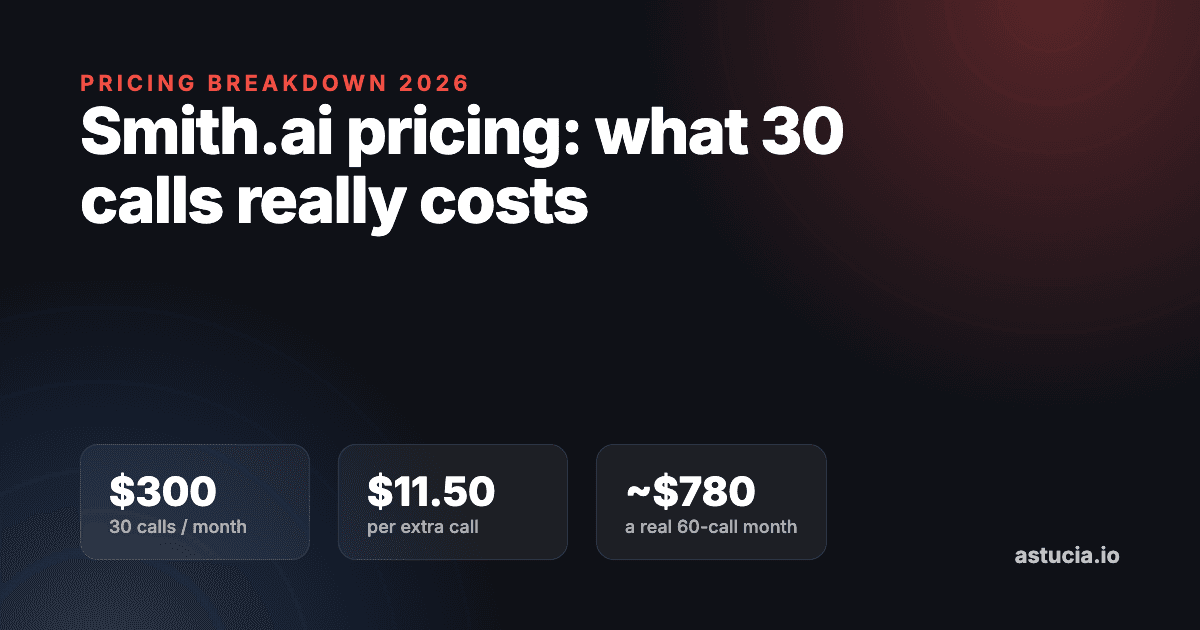
Smith.ai combines AI with human agents for a hybrid approach. Their system handles initial screening with AI and escalates complex calls to live operators. It's a solid choice for law firms and medical practices with high call volumes.
The trade-off is pricing. Smith.ai charges per call, which can add up quickly during busy months. For businesses with unpredictable call volumes, this model creates budget uncertainty. See our full Smith.ai alternative comparison for a detailed breakdown.
3. Ruby Receptionists — Best Legacy Answering Service
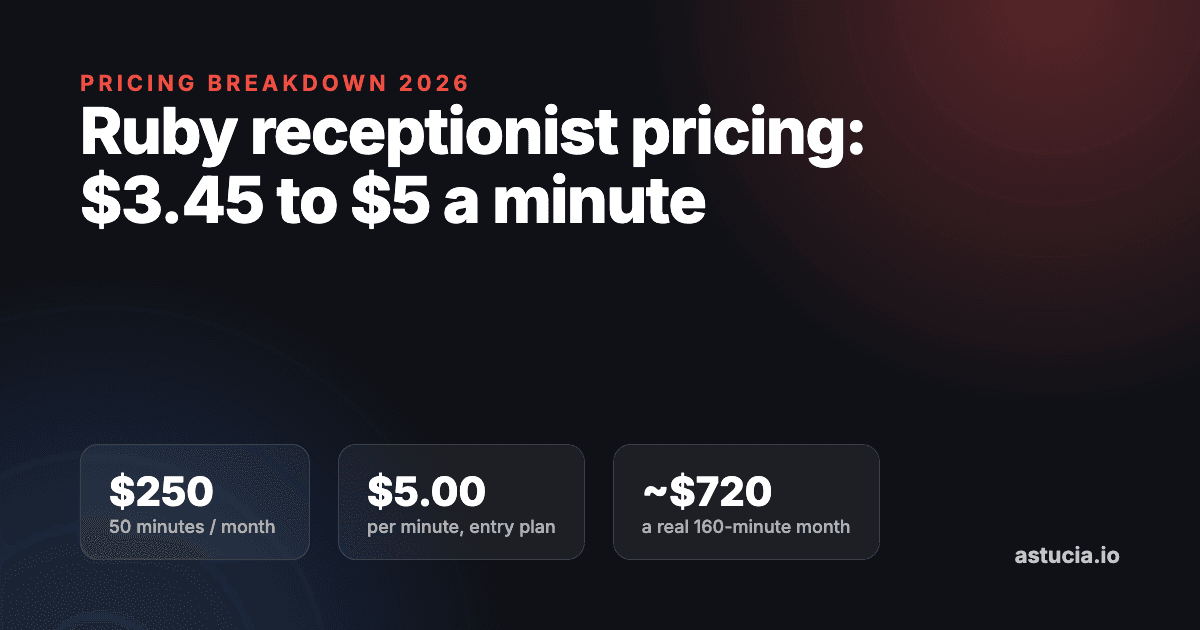
Ruby is a well-established virtual receptionist service that has added AI features to supplement their human operators. They're known for friendly, professional call handling and have a strong reputation in the legal industry.
However, Ruby is primarily a human service with AI assist — not an AI-first solution. Monthly costs are significantly higher than pure AI options, and you're still dealing with human limitations like shift schedules and training gaps.
4. Dialzara — Budget-Friendly Starter Option
Dialzara offers a straightforward AI receptionist at a lower price point. It handles basic call answering, message taking, and simple call routing. For solopreneurs or micro-businesses with light call volumes, it can be a reasonable entry point.
The limitation is depth. Dialzara's AI lacks the advanced business training and integration capabilities that growing businesses need. As your call volume and complexity increase, you'll likely outgrow it.
5. Rosie AI — Focused on Home Services
Rosie targets home service companies specifically — HVAC, plumbing, electrical, and similar trades. Their AI is pre-trained on common home service scenarios and integrates with popular field service management tools.
The specialization is a strength if you're in home services, but a limitation if you operate in other industries. The AI may struggle with questions outside its pre-built knowledge base.

6. Goodcall — Simple Setup for Basic Needs
Goodcall offers a no-frills AI receptionist that's quick to set up. It answers calls, takes messages, and provides basic business information. The setup process takes minutes rather than days, which appeals to busy owners who want immediate coverage.
The simplicity comes at the cost of customization. Goodcall's AI operates from templates rather than deep business training, so callers may not get the detailed, accurate answers they need about your specific services.
7. Bland AI — Developer-Focused Platform
Bland AI is a developer-friendly platform for businesses with technical teams that want full control over their AI receptionist's behavior. It offers extensive API access and customization options for companies that prefer to build their own workflows.
For most small business owners without a developer on staff, Bland AI requires too much technical setup to be practical. It's powerful but not plug-and-play.
How to Choose the Best AI Receptionist for Small Business
Picking the right solution comes down to five questions:
- What's your call volume? Light callers (under 100/month) may be fine with a basic option. Businesses handling 200+ calls need robust scalability.
- How complex are your calls? If callers ask detailed questions about services and pricing, you need an AI with deep business training — not just a message-taker.
- Do you need appointment booking? If scheduling is core to your business, calendar integration is non-negotiable.
- What's your budget? Per-minute pricing punishes growth. Flat-rate plans protect your margins as call volume increases.
- Do you need multichannel coverage? If you also get web inquiries, look for a solution that unifies phone and chat leads.
For most small businesses, the answer points to a solution that combines deep customization with simple pricing and strong integrations. That's exactly what Astucia was built to deliver.
Why Small Businesses Are Switching to AI Receptionists in 2026
The shift isn't just about cost savings — though those are significant. Small businesses are switching because customer expectations have changed. People expect immediate answers. They expect businesses to be available when they need them. And they expect personalized service, not generic scripts.
AI receptionists meet all three expectations at a price point that makes sense for small businesses. No more choosing between quality and affordability. Learn more about AI receptionist pricing to understand the full cost picture. And if you want to understand what to look for in the underlying technology, our guide on AI phone answering services covers the key capabilities in detail. For a broader look at how AI handles the entire front desk workflow, see our guide to AI front desk solutions.
Key Features to Compare When Choosing an AI Receptionist
Before you commit to any platform, run through this feature checklist. Not every business needs every feature, but knowing what's available helps you avoid overpaying for tools you don't use — or underpaying for a solution that can't grow with you.
Must-have features for most small businesses:
- Call answering with natural language understanding
- Appointment scheduling with calendar sync
- Custom business training (not generic scripts)
- CRM integration for automatic lead logging
- Missed-call text back for immediate follow-up
Nice-to-have features depending on your industry:
- Multilingual support for diverse customer bases
- Call recording and transcription for quality review
- Advanced call routing by department or urgency
- Analytics dashboard with call volume and conversion tracking
- Integration with field service management tools
The best platforms offer transparent pricing that includes core features without nickel-and-diming you for essentials like after-hours coverage or basic reporting.
Ready to see how an AI receptionist works for your business? Book a free demo and experience the difference firsthand.
Keep Reading
- Complete Guide to AI Receptionists — Everything you need to know about AI receptionists for small business
- How Much Does an AI Receptionist Cost? 2026 Pricing Breakdown — Full pricing breakdown so you can budget before you buy
- What to Look for in an AI Phone Answering Service — Key features and capabilities to evaluate when choosing a solution
- AI Answering Service for Auto Repair Shops — How auto repair shops use AI to stop losing 35% of callers
- AI Receptionist for Law Firms — How law firms cut costs with AI reception vs. virtual receptionists
- AI Receptionist for Property Management (2026): 7 Use Cases — How property managers handle tenant calls, maintenance requests, and showings 24/7