When a potential customer searches for a local business, one of the first things they see is your star rating. Before they read your website, check your pricing, or call your number — they look at your reviews. That snap judgment happens in seconds and shapes every interaction that follows.
For local businesses, reviews are no longer a nice-to-have. They are the primary trust signal that separates businesses that win new customers from those that get passed over. A business with 4.8 stars and 200 reviews closes more deals than a business with 4.2 stars and 12 reviews — even if the service itself is identical. The perception built by those reviews determines the outcome.
The problem is that most small businesses leave this entirely to chance. They serve customers well, hope someone leaves a review, and check their profile every few weeks. The result is a thin, uneven review profile that undersells the quality of their work.
Automated review management changes that equation entirely. It turns a passive, unpredictable process into a consistent system — one that reliably captures reviews from satisfied customers, monitors your reputation across platforms, and helps you respond to feedback in a way that builds trust with future prospects. This guide walks through how it works, who it serves, and what a high-performing review strategy looks like in practice.
Why Reviews Matter for Local Business
Reviews Are a Google Ranking Factor
Google's local search algorithm — the system that determines which businesses appear in the Map Pack — weighs review signals heavily. Quantity, recency, and rating all influence your local ranking. A business with a steady stream of recent reviews signals to Google that it is active, trusted, and relevant. A business with no new reviews in six months signals stagnation.
The impact is direct: businesses that rank in the top three local results capture a disproportionate share of clicks. Studies consistently show that the top Map Pack position receives more than 40% of local search traffic. Reviews are one of the most actionable levers available to improve that ranking.
Consumers Trust Reviews as Much as Personal Recommendations
"93% of consumers say online reviews influence their purchasing decisions." — BrightLocal Local Consumer Review Survey
That number is not surprising to anyone who has searched for a restaurant, contractor, or service provider recently. What is surprising is how high the bar has gotten. Consumers today do not just want to see a high rating — they want to see volume, recency, and authentic responses.
- Star rating threshold: Most consumers will not engage with a business rated below 4.0 stars.
- Recency matters: Reviews older than three months carry less weight with consumers evaluating a business today.
- Response signals: Businesses that respond to reviews — positive and negative — are seen as more professional and accountable.
Reviews Directly Impact Conversion Rates
A well-maintained review profile does not just attract more clicks — it converts them. When prospects land on your website or Google Business Profile and see consistent five-star reviews with specific details about the service experience, their hesitation drops. Social proof answers the questions they have not yet asked.
The businesses with the strongest review profiles close more deals at higher margins because they spend less time overcoming skepticism. Trust has already been established before the first conversation.
The Review Collection Problem
Most businesses understand that reviews matter. The challenge is execution. Collecting reviews consistently is harder than it looks, and most businesses struggle for the same predictable reasons.
The Friction Is Too High
Asking a happy customer to leave a review puts the entire burden on them. They have to remember to do it, find your Google Business Profile, log into their Google account, write something thoughtful, and submit. Even a motivated customer faces four or five steps between intention and action. Most never follow through — not because they are unhappy, but because life gets in the way.
Timing Is Off
The best moment to ask for a review is immediately after the service is completed, when the customer's satisfaction is highest and the experience is fresh. Most businesses miss this window entirely. They ask at the wrong moment — weeks later in a newsletter, or not at all — and conversion rates drop sharply as time passes.
Manual Outreach Does Not Scale
A business owner who personally asks every customer for a review might see decent results when they have ten customers a month. At fifty or a hundred, personal outreach becomes impossible to maintain. The process breaks down, review collection becomes sporadic, and the profile stagnates.
The Result: An Underselling Profile
The outcome is a Google Business Profile that does not reflect the actual quality of the business. A company with hundreds of satisfied customers each year might have thirty-five reviews to show for it. That gap between real satisfaction and visible social proof costs real revenue.
How Automated Review Management Works
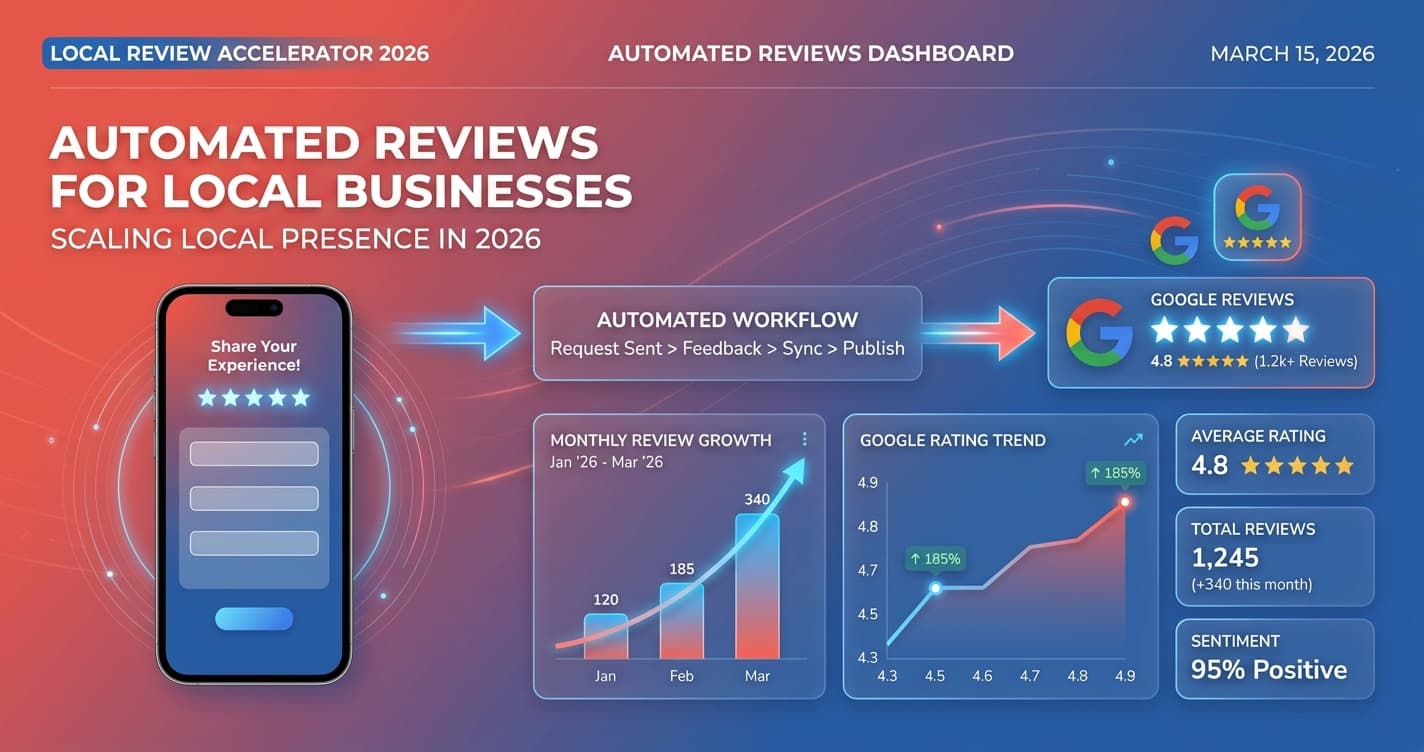
Automated review management closes the gap between customer satisfaction and visible social proof by systematically capturing reviews at the right moment, through the right channel, without requiring manual effort from the business owner or staff.
Here is how the full funnel works:
Step 1: Service Completion Trigger
The process begins when a service is marked complete — in a CRM, scheduling tool, or point-of-sale system. This trigger fires automatically, initiating the review request sequence without any action required from staff.
Why this matters: Timing is the single biggest driver of review conversion. Requests sent within 24 hours of service completion consistently outperform requests sent days later.
Step 2: Automated Request via SMS or Email
The system sends a personalized review request to the customer via text message or email — or both, in sequence. The message is brief, friendly, and includes a direct link to the business's Google Business Profile review page.
"Hi [Name], thanks for choosing [Business]. We hope your experience was great — if so, we'd love a quick Google review. It only takes a minute: [direct link]"
SMS outperforms email for most local service businesses. Text messages are opened at rates above 90%, compared to 20–30% for email. The combination of SMS followed by email if there is no response maximizes reach without being intrusive.
Step 3: Direct Link to Review Platform
The review request link bypasses the search step entirely, landing the customer directly on the review submission page. This single change — eliminating the friction of finding the business profile — dramatically increases completion rates.
For businesses active on multiple platforms (Google, Yelp, Facebook), the system can direct customers to the highest-priority platform or rotate based on where the profile needs the most attention.
Step 4: Review Posted
Once a customer submits a review, it appears on the platform and contributes to the business's rating and review count. Over time, a consistent cadence of new reviews builds a profile that ranks better, converts more prospects, and accurately represents the quality of the business.
Step 5: Monitoring and Response
The system monitors all review platforms for new reviews — positive and negative — and alerts the business when one is posted. This enables timely responses that demonstrate engagement and professionalism to future readers.
Key Features of a Review Automation System
A well-built review automation system is more than a message scheduler. The best implementations combine several capabilities into a single workflow.
Automated Review Requests (SMS and Email)
The core function: triggering personalized, timely review requests based on service completion. The best systems allow customization of message content, timing, and channel so requests feel authentic rather than generic. Personalization — using the customer's name, referencing the specific service — meaningfully increases response rates.
Sequences can be configured to send a single request or a follow-up if the first goes unanswered. The follow-up is typically sent 48–72 hours later and frames the ask slightly differently to avoid feeling repetitive.
Timing Optimization
Not every business has the same optimal request window. A roofing contractor whose customer just had a new roof installed will get the best response on the day of completion. An accounting firm whose client just had their taxes filed might get a better response two days later, once the stress of tax season has fased.
Configurable timing rules let the system adapt to the service cycle of each specific business, rather than applying a one-size-fits-all delay.
Review Monitoring Across Platforms
Knowing about new reviews quickly — especially negative ones — is critical. Review monitoring tools track activity across Google, Yelp, Facebook, and industry-specific platforms, sending alerts so the business can respond while the review is still fresh and visible.
Unmonitored review profiles are a liability. A one-star review that sits without a response for two weeks signals to every future reader that the business either does not care or does not pay attention.
Response Management
Responding to reviews — both positive and negative — is one of the highest-leverage activities for reputation management. It shows future prospects that the business is attentive, accountable, and professional.
Automated response tools can generate draft responses based on the content and sentiment of the review, which the business owner can approve and post in minutes. This removes the bottleneck of composing responses from scratch while keeping the final output authentic.
For more on building a systematic approach to collecting reviews through automation, see our post on how to automate Google reviews for your business.
Sentiment Analysis
Advanced systems analyze the language of incoming reviews to identify patterns — common compliments, recurring complaints, and service-specific feedback. This gives business owners a real-time view of what customers consistently appreciate and where there may be operational gaps.
Sentiment data is most valuable when it surfaces trends rather than individual data points. A single negative mention of wait times is noise; ten mentions over two months is a signal worth acting on.
Multi-Platform Management
Most businesses have a primary review platform — usually Google — but maintaining a presence on secondary platforms strengthens overall reputation and provides additional signals to search engines. A unified dashboard that manages requests, monitoring, and responses across all active platforms reduces the management overhead to a single workflow.
Industry Applications
Review automation applies across virtually every local service business, but the specific configuration and approach varies by industry. Here is how it plays out in three common categories.
Roofing and Exterior Contractors
Roofing is a high-ticket, infrequent purchase driven almost entirely by trust. A homeowner who needs a new roof will often evaluate two or three companies before making a decision, and the review profile is frequently the deciding factor.
The challenge for roofing companies is that the service window is compressed. The job is completed in a day or two, the customer is relieved it is over, and there is a narrow window to capture their satisfaction before they move on. A same-day review request sent when the crew wraps up — while the customer is standing in their driveway looking at a clean new roof — captures that satisfaction at its peak.
Roofing companies that run consistent review campaigns often see their Google Business Profile climb into the local Map Pack for high-intent searches like "roof replacement [city]" within three to six months. That organic visibility can generate multiple qualified leads per week without additional ad spend.
For roofing-specific strategies, see our detailed breakdown of building a Google Reviews system for roofing companies.
Accounting and Professional Services Firms
Accounting firms face a different challenge: trust in a professional services context is built on credibility and discretion, not speed. Clients choose an accountant based on confidence that they are competent, reliable, and trustworthy with sensitive financial information.
Reviews are particularly powerful here because they are rare. Most accounting firms have thin review profiles compared to the volume of clients they serve, which means a modest investment in review automation can produce an outsized competitive advantage.
Timing for accounting firms aligns with engagement milestones — after tax returns are filed, after a bookkeeping review is delivered, after a planning session wraps up. These are natural moments of satisfaction when the client feels the value of the relationship clearly.
The message framing for professional services should reflect the tone of the relationship — professional, appreciative, not transactional. A well-worded request that acknowledges the client's trust and asks for a brief reflection performs better than a generic five-star ask.
To see a detailed funnel design for accounting practices, read our post on building a review funnel for accounting firms.
Home Services (HVAC, Plumbing, Cleaning)
Home services businesses operate on repeat service cycles and referral networks. A customer who has a great experience with their HVAC tune-up is not just a potential reviewer — they are a potential long-term client and a referral source for neighbors and family members.
Review automation compounds in home services because satisfied customers who leave reviews are also more likely to book future services. The review request is often the first touchpoint in an ongoing engagement sequence, not a one-time ask.
For HVAC specifically, the volume of service calls creates consistent review collection opportunities throughout the year. A business completing fifteen to twenty service calls per week can realistically add ten or more new reviews monthly with a well-configured automation in place. Over a year, that is a profile with 120+ reviews — a level that dominates most local markets.
The timing optimization for HVAC and similar trades should account for service type: post-installation requests can go out same-day, while maintenance visit requests can go out the following morning once the customer has had time to confirm everything is working.
Building a Review Strategy That Works
Automation handles the execution, but the strategy — when to ask, how to ask, and how to respond — determines the results. Here is how to build a review strategy that performs consistently.
When to Ask
The golden rule: ask when satisfaction is highest. For most service businesses, that is within 24 hours of service completion. The specific window depends on the service:
| Service Type | Optimal Request Timing |
|---|---|
| Same-day service (HVAC, plumbing, cleaning) | Same day, within 2–4 hours of completion |
| Multi-day project (roofing, renovation) | Same day as project completion |
| Professional engagement (accounting, consulting) | Within 24 hours of deliverable |
| Ongoing service (monthly bookkeeping, landscaping) | After each major milestone or monthly |
How to Ask
The language of the request matters. The best-performing review requests are:
- Personalized — Use the customer's first name and reference the service
- Brief — Two to three sentences maximum; respect the customer's time
- Low-pressure — Frame it as an ask, not an expectation
- Action-oriented — Include a direct link with a clear call to action
Avoid language that feels transactional or manufactured. Phrases like "We strive for five stars" or "Please leave us a five-star review" reduce authenticity and can violate Google's review policies.
Handling Negative Reviews
Negative reviews are inevitable, and how you handle them matters more than the review itself. A thoughtful, professional response to a one-star review demonstrates accountability and often reassures future prospects more than the review concerns them.
A strong response to a negative review:
- Acknowledges the customer's experience without being defensive
- Takes responsibility where appropriate
- Offers a resolution or invites direct contact to make it right
- Keeps the tone professional — responses are written for future readers, not just the reviewer
"Thank you for sharing your feedback. We're sorry to hear your experience didn't meet expectations — this isn't the standard we hold ourselves to. Please contact us directly at [email] and we'll make it right."
What to avoid: arguing with reviewers, dismissing feedback, or posting defensive responses that escalate the situation. Future prospects reading the exchange will form their judgment based on your tone, not the reviewer's.
Response Templates for Positive Reviews
Responding to positive reviews reinforces the relationship with the reviewer and signals engagement to future prospects. Responses should:
- Thank the customer by name when possible
- Reference a specific detail from their review to show it was read
- Reinforce a key value proposition naturally
- Keep it brief — two to three sentences
Getting Started with Review Automation
If your Google Business Profile has fewer reviews than the number of satisfied customers you have served in the last year, there is a gap worth closing. Every week without a systematic review collection process is a week of potential social proof that disappears.
The businesses that dominate their local markets on Google are rarely the ones that provide the best service in isolation — they are the ones that have built the systems to make their quality visible. A consistent review profile is the single most accessible competitive advantage available to a local service business.
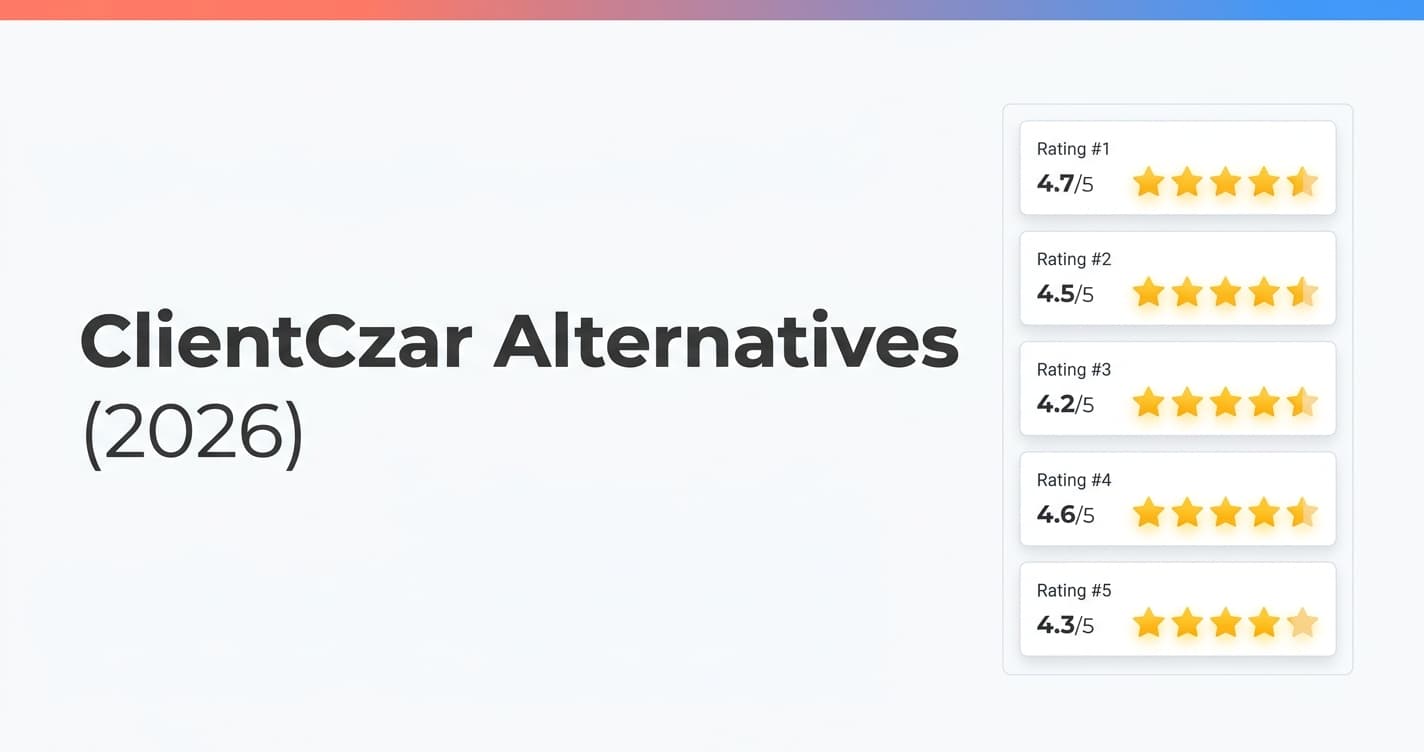
If you are comparing platforms before you commit, our breakdown of ClientCzar alternatives ranks the five best review-automation tools for SMBs by price and features.
The process to get started is straightforward:
- Audit your current review profile — count your reviews, note your rating, and identify the gap between your customer volume and review volume
- Map your service completion touchpoints — where in your workflow does a job get marked complete?
- Configure your review automation — set up request sequences, timing rules, and response monitoring
- Launch and monitor — watch review volume increase in the first 30–60 days and adjust timing or message copy based on response rates
Astucia's Review Automation service handles this end to end — from setup and configuration to ongoing monitoring and response management. If you are ready to turn satisfied customers into visible social proof, book a demo to see how it works for your business.
Related resources: How to Automate Google Reviews | Google Reviews for Roofing Companies | Review Funnel for Accounting Firms | ClientCzar Alternatives: 5 Best Review Tools