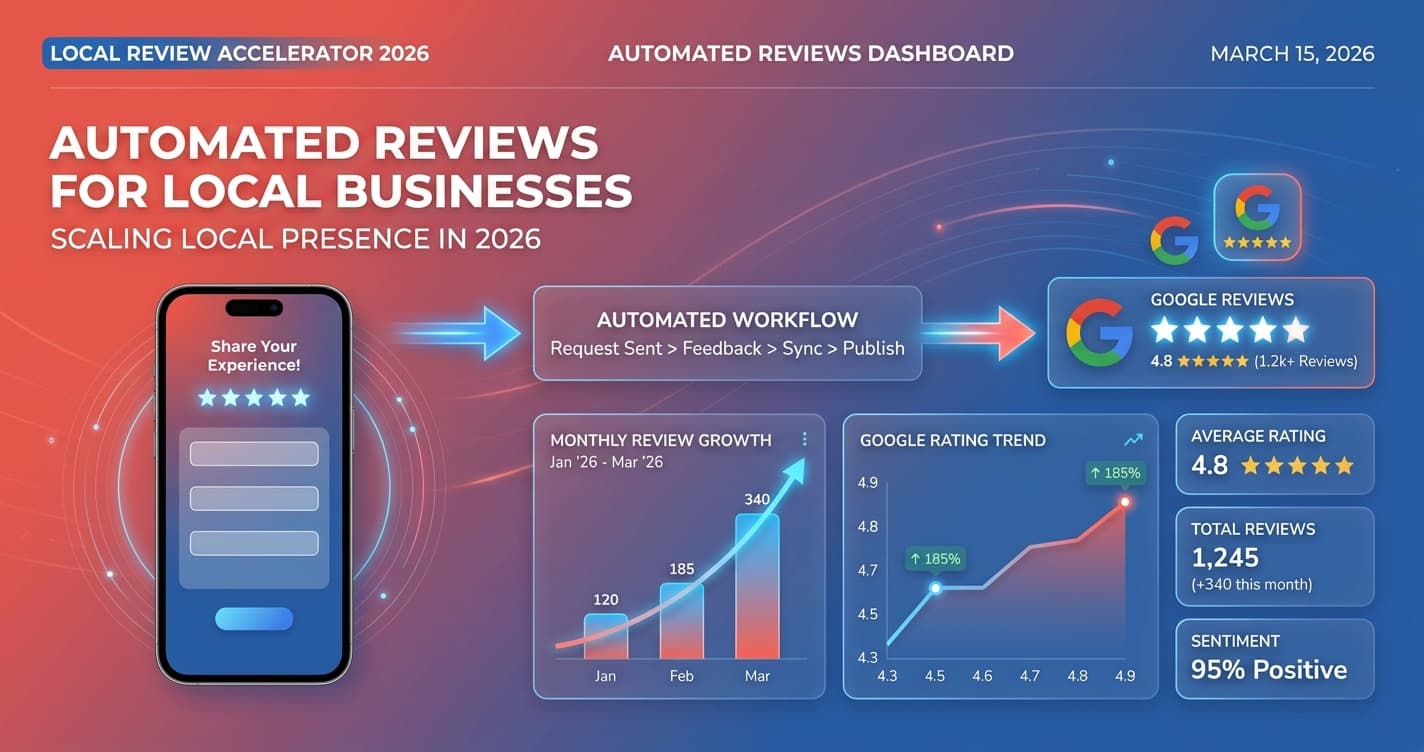
Review automation for auto repair shops sends a text right after every job, asking customers to leave a Google review while satisfaction is highest. Shops using automated systems collect 2–4x more reviews monthly, pushing their rating toward the 4.5+ threshold that wins map pack rankings. Astucia handles the full cycle: request, reminder, and response.
Sixty-seven percent of consumers won't choose a business with fewer than 4 stars. For auto repair shops, where trust is the deciding factor, the number is higher — BrightLocal's 2024 Local Consumer Review Survey found that 73% of customers only consider local businesses with at least a 4-star average. Yet the typical auto repair shop sits at 3.8 stars with fewer than 60 reviews.
The problem isn't service quality. It's follow-up. Most happy customers never leave a review because no one asked — or the ask arrived a week later in a forgotten email. Review automation for auto repair fixes both the timing and the friction, turning satisfied customers into 5-star reviewers before they pull out of the lot.
For the complete playbook on building your local reputation, read the Complete Guide to Review Automation for Small Businesses.
Why Do Google Reviews Matter So Much for Auto Repair Shops?
Auto repair is a high-trust purchase. Customers choosing a shop they've never visited rely on Google reviews as their primary signal — more than referrals, website design, or price.
Three ways reviews drive auto repair revenue:
Map pack visibility. Google's local 3-pack (the map results at the top of "auto repair near me" searches) weights review count and star rating heavily. Shops with 100+ reviews at 4.5 stars consistently outrank shops with 20 reviews at 5.0 stars, because volume signals credibility over time.
Conversion from click to call. A listing showing 4.7 stars with 340 reviews converts at roughly twice the rate of one showing 3.9 stars with 22 reviews — even when both appear on the same page. That gap translates directly into booked jobs.
Resilience to bad reviews. A single 1-star review matters far less when it's surrounded by 200+ four and five-star reviews. Shops running review automation accumulate enough positive reviews that isolated complaints can't sink their average.
How Does Review Automation Work for Auto Repair Shops?
Review automation for auto repair shops connects to your service workflow — through your shop management software (Tekmetric, ShopWare, Mitchell, or similar) or a manual trigger — and fires a review request at exactly the right moment.
The typical sequence:
- Job closed. The repair is complete and the invoice is marked paid.
- Text sent automatically. Within 30–90 minutes, the customer receives a personalized SMS: "Thanks for trusting [Shop Name] with your [vehicle]! If you have a moment, a review means the world to us: [direct Google link]."
- One-tap review. The link opens directly to your Google review form — no searching, no navigation, no friction.
- Optional reminder. If no review is posted within 48 hours, a single follow-up text goes out. This step alone typically doubles review conversion.
- Response triggered. When a review is posted, a response template or AI-generated reply goes out within hours — keeping your Google profile active and showing prospective customers that you're engaged.
What separates this from manually asking customers is consistency. You can't remember to follow up with every customer after a busy Saturday. Automated systems do it for every job, every time — without any extra staff effort.
In Astucia's experience working with service businesses, shops that implement automated text follow-up typically jump from 2–3 reviews per month to 15–25 reviews per month within 60 days.
Free Resource
Free Call Script Pack
Calculate your missed-call revenue loss and get 12 proven call scripts for AI receptionists.
Download FreeHow Many Reviews Do You Need to Rank in the Map Pack?
There's no number Google publishes, but analysis of map pack rankings across auto repair markets shows consistent patterns:
- Small market (city under 100K): 40–80 reviews at 4.4+ stars is typically enough to reach the top 3.
- Mid-size market (100K–500K): 100–200 reviews at 4.5+ stars.
- Major metro (500K+): 300–500+ reviews with consistent recent activity (last 90 days).
Recent activity matters more than total count. Google's local algorithm rewards shops adding 10+ reviews per month over shops with 500 reviews from three years ago. This is exactly why review automation for auto repair — which generates a steady, ongoing stream — outperforms any one-time push to collect reviews.
Velocity also builds trust in the listing itself. Customers scanning map results notice "Most recent review: 4 months ago" versus "Most recent review: 2 days ago." That recency signal affects their decision before they even click.
What Should You Look For in an Auto Repair Review Tool?
Not every review platform is built for service businesses. When evaluating options, prioritize:
SMS-first delivery. Email open rates average 20–25%. Text open rates average 98%. Auto repair customers — many of whom dropped off a vehicle and went back to work — aren't checking email. Your review request platform must lead with SMS to reach them.
Customizable send timing. The ideal window is 30–90 minutes post-invoice. Too soon (during pickup) feels pushy. Too late (next morning) misses the emotional peak. Adjustable timing lets you match your shop's specific workflow.
Negative feedback routing. When a customer rates their experience 1–3 stars, good systems redirect them to a private feedback form instead of directly to Google. Capturing dissatisfied customers privately — before they publish — is standard practice and compliant with Google's review policies when no incentives are involved.
Response support. A response on every review — positive and negative — signals active management and typically improves local ranking signals. Manually responding to 200 reviews per year isn't realistic. Templates or AI-generated responses make it sustainable.
Flat-rate pricing. Per-review or usage-based pricing adds up fast for a shop doing 250–400 jobs per month. Flat monthly pricing makes costs predictable regardless of volume.
Can Review Automation Help You Respond to Negative Reviews?
Yes — and this matters more than most owners realize. Google's review response guidelines encourage businesses to respond to all reviews. Fast, professional responses to negative reviews demonstrate accountability and often turn a 1-star first impression into a second chance.
Here's how review automation for auto repair handles the negative review workflow:
Immediate alerts. When a negative review is posted, you receive an instant notification — not a discovery three weeks later when the damage is done.
Response templates. Pre-built replies for common friction points (unexpected repair costs, longer-than-expected turnaround, miscommunication on estimates) let you respond within the hour. Prospective customers reading that response see a shop that takes service seriously.
Dispute guidance. Not every 1-star review is legitimate. Competitor reviews, spammer accounts, and cases of mistaken shop identity do occur. A solid review management system includes guidance on flagging reviews under Google's content policies for assessment.
The goal isn't a perfect 5.0 rating — it's a credible, active rating with real customer interactions and visible management that converts new visitors into booked appointments.
How Long Does It Take to Set Up Review Automation for Auto Repair?
For most shops, implementation takes one afternoon:
- Connect your shop management software or set up a webhook (legacy systems can use a daily CSV export as a fallback)
- Customize your review request message with your shop name, vehicle reference, and Google link
- Set your send timing and optional reminder window
- Test with a team member's number before going live
- Monitor your first 30 days
Within 90 days, most shops see measurable movement in their Google rating and review count — often enough to shift their map pack position and increase inbound call volume from organic search.
Keep Reading
- How Cleaning Companies Use Review Automation to Beat Competitors
- Respond to Negative Reviews: 5-Step Small Business Guide
- How to Get More Google Reviews Automatically
Ready to stop leaving reviews on the table? Astucia's review automation is built for service businesses — SMS-first delivery, flat-rate pricing, and response management included. Book a free demo to see it running in your shop.