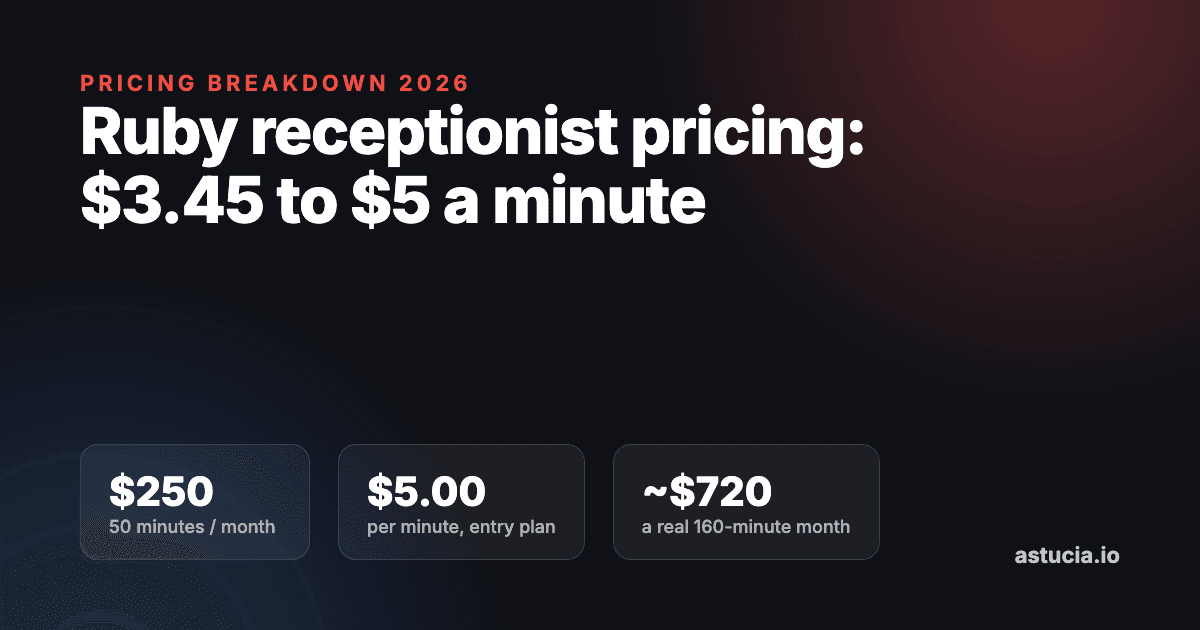
Ruby receptionist pricing in 2026 runs from $250 a month for 50 minutes to $1,725 a month for 500. That is $5.00 per minute on the smallest plan and $3.45 on the largest, with overage billed at $3.30 to $5.40 a minute. A business that uses 160 minutes a month pays roughly $665 to $720 for a receptionist that answers when a person is on the line.
Ruby is the best-known name in live virtual reception, and for good reason: the receptionists are US-based, trained, and reviewers like them. The question small businesses keep asking on Capterra and Software Advice is not whether Ruby is good. It is whether it is worth five dollars a minute. This is the full breakdown of Ruby receptionist pricing: how minutes are counted, what overage costs, what a real month looks like, and when a managed AI receptionist is the better decision.
If you are still working out what an AI receptionist is and how it differs from a live service, the complete guide to AI receptionists covers the basics. For the whole market in one place, see AI receptionist pricing: DIY, bundled or managed.
What are Ruby's receptionist plans in 2026?
Ruby publishes its plans on ruby.com/pricing. The live receptionist tiers as of September 2026:
| Plan | Minutes per month | Monthly price | Price per included minute |
|---|---|---|---|
| Starter | 50 | $250 | $5.00 |
| Small Business | 100 | $395 | $3.95 |
| Popular | 200 | $720 | $3.60 |
| Growing Business | 500 | $1,725 | $3.45 |
All plans include 24/7 live answering, bilingual receptionists, AI call transcripts, custom call handling, appointment scheduling and HIPAA-compliant handling. Ruby states there are no activation, onboarding, setup or customization fees, which is genuinely rare in the category.
Ruby also sells live chat, $143 a month for 10 chats up to $520 for 50, and bundles chat with reception at a 20% discount. Add-ons such as payment collection, lead qualification and outbound assistance are available on every tier and priced with sales.
How does Ruby count minutes?
The unit in Ruby receptionist pricing is the minute, and this is where it surprises people. Billable time is not only the conversation. Reviewers and comparison sites report that after-call work, such as notes, CRM entry and message delivery, is included in billed minutes, which inflates the effective cost per call by an estimated 20 to 35 percent.
A three-minute call can therefore bill as four. Across a month that is the difference between staying inside the plan and paying overage, and it is the single most useful thing to ask Ruby's sales team to explain before you sign: exactly which seconds count.
Free Resource
Free Call Script Pack
Calculate your missed-call revenue loss and get 12 proven call scripts for AI receptionists.
Download FreeWhat does Ruby charge for overage?
Minutes above the plan are billed in arrears. Reported rates run from about $5.40 a minute on the 50-minute plan down to roughly $4.35 on the 200-minute plan, with the largest plans lowest. The smallest customers pay the highest overage, which is the opposite of what a growing business wants, and it means a good month for the business is an expensive month on the phone bill.
What does a real month cost on Ruby?
Take a dental office that takes 40 calls a month averaging three minutes, with a minute of after-call work on each. That is about 160 billable minutes.
On the Small Business plan (100 minutes): $395 base plus 60 overage minutes at around $4.50. Total: about $665.
On the Popular plan (200 minutes): $720, with 40 minutes unused. Total: $720.
Either way, a modest call volume costs $665 to $720 a month. The 2021 class-action settlement over billing practices is old news and the company has changed since, but it is the reason experienced buyers read the minute definition before they sign.
How does Ruby receptionist pricing compare to Smith.ai and to AI receptionists?
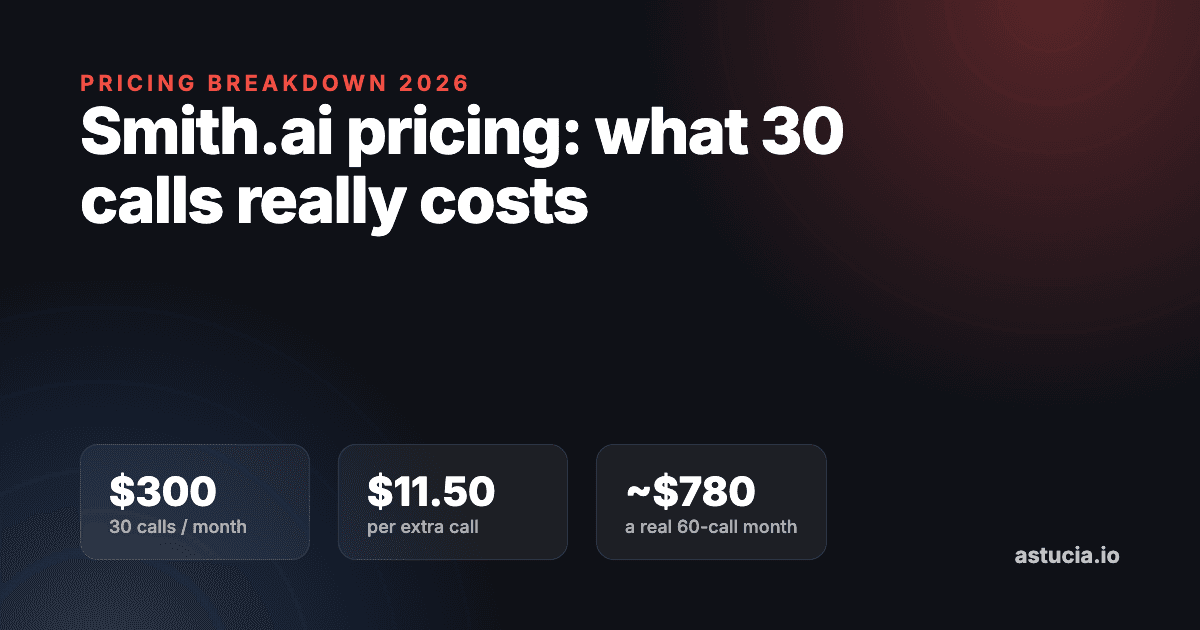
Ruby's closest live-answering rival is Smith.ai, which bills per call rather than per minute: $300 a month for 30 calls, $810 for 90, with $8.50 to $11.50 per extra call and per-call add-ons for booking and intake. Our Smith.ai pricing breakdown works the same 60-call month out at $780 to $945. Long calls favor Smith.ai's per-call model; short, frequent calls favor Ruby's per-minute model; neither is cheap for a business that gets a lot of both.
AI receptionists price on a different axis entirely. Self-serve software runs $29 to $199 a month with large or unlimited allowances, and a managed service is a flat monthly amount that includes setup and ongoing work rather than a meter. The managed-versus-DIY comparison for HVAC shows the arithmetic for a contractor.
What should you ask Ruby before signing?
Four questions settle most of the surprises in Ruby receptionist pricing. First, which seconds are billable: ring time, hold time, the conversation, and the after-call work. Second, what the overage rate is on the specific plan you are buying, in writing, since the published page does not state it. Third, whether unused minutes roll over (they generally do not) and what the process is to move down a tier after a slow month. Fourth, how transfers are billed when the receptionist patches a caller through to you, because that minute is usually counted too. The answers will not change the plan prices, but they will tell you which plan you actually need, and a plan that fits is the single biggest saving available.
Where Ruby is worth it
Ruby earns its price when the caller must reach a warm, human voice: law firms doing sensitive intake, practices where the receptionist is part of the brand, businesses whose calls are long conversations rather than bookings. The receptionists are consistently rated well, the bilingual coverage is real, and the no-setup-fee policy means trying it costs one month.
Where a managed AI receptionist is the better buy
Most small business calls are not long conversations. They are "are you open," "can I book Tuesday," "my furnace stopped," and "how much is a cleaning." An AI receptionist in 2026 handles those in under two seconds, 24 hours a day, books the appointment, texts the caller back, and routes the emergency to the owner. And it does not bill by the minute, so a busy week costs the same as a quiet one.
The trade-off with AI receptionist software is the work of setting it up and keeping it tuned. A managed AI receptionist removes that trade-off: Astucia runs the onboarding call, trains the AI on your services, pricing guidelines and FAQs, connects your calendar and CRM, forwards your line, and reviews transcripts monthly. Most businesses are live within 48 hours.
Set that against $665 to $720 a month under Ruby receptionist pricing, for coverage that depends on a person being available, and the decision usually makes itself.
Keep Reading
- AI Receptionist Pricing (2026): DIY, Bundled, or Managed?
- Smith.ai Pricing (2026)
- AI Receptionist vs Virtual Receptionist: 5 Facts
- Answering Service vs AI Receptionist
Key takeaway
Ruby receptionist pricing is premium and per minute, and the minute includes after-call work. If your callers need a person, Ruby is one of the best people-based options there is. If your callers need an answer, a booking and a follow-up text, book a free 20-minute call, hear a managed AI receptionist handle your own FAQs live, and compare the two numbers before you commit to a minute plan.