RingCentral's AI Receptionist is a default toggle, not a configured solution. While it handles basic call routing for businesses already on the RingCentral platform, it lacks the custom training, industry-specific workflows, and human oversight that small businesses need to capture and convert inbound leads. Astucia's managed AI receptionist is purpose-built and configured for your specific business from day one.
When RingCentral announced its AI Receptionist (AIR) feature in 2025, the pitch landed hard. Over 400,000 businesses already run on RingCentral — and suddenly, every one of them could say their AI receptionist was already included. Just flip a switch.
But there is a meaningful difference between a built-in feature and a working solution. For the HVAC contractor fielding emergency calls at 11 p.m., the law firm screening case inquiries, or the dental office trying to fill its next open slot, "included" is not the same as "configured for your business."
This guide breaks down exactly what the RingCentral AI Receptionist does, where it falls short for SMBs, and how a managed approach delivers better results for businesses that cannot afford to lose a single inbound call.
What Does RingCentral's AI Receptionist Actually Do?
RingCentral AIR is an intelligent auto-attendant layer built on top of the existing RingEX phone platform. Out of the box, it can:
- Answer calls with a customizable recorded or AI-generated greeting
- Route calls to the right department, extension, or team
- Answer frequently asked questions using voice AI
- Transcribe voicemails and deliver summaries via email or the mobile app
- Handle overflow calls when staff lines are busy
For a large enterprise that already uses RingCentral and just needs better call routing, AIR is a practical upgrade over a traditional IVR phone tree. You configure it inside the admin portal, set your routing rules, and it runs.
The problem is that this is the full extent of what the RingCentral AI Receptionist does by default. There is no industry-specific training. There is no lead capture beyond voicemail. There is no mechanism to collect a prospect's name, contact information, or intent — and no system to push that information into your CRM. For businesses where every call represents a potential customer, that gap is significant.
Is the RingCentral AI Receptionist Right for Your Business?
Whether RingCentral AIR works for your business comes down to one question: what do you actually need inbound calls to accomplish?
If your goal is to route internal calls more efficiently, reduce hold times, and give employees a better phone experience, RingCentral AIR is a reasonable add-on — especially if you're already paying for a RingEX plan.
But if your business depends on converting inbound calls into appointments, jobs, or signed clients, the RingCentral AI Receptionist has four structural limitations:
1. No lead capture. AIR routes calls and records voicemails. It does not collect caller information in a structured way, qualify intent, or push prospect data to your CRM. A caller who reaches voicemail and hangs up is effectively a lost lead.
2. No industry-specific training. A roofing company needs to ask callers about storm damage and insurance. A family law firm needs to screen case type and jurisdiction. A chiropractic office needs to book new patient appointments and collect insurance. RingCentral AIR has none of that built in — and configuring it yourself requires significant technical effort with no guarantee of results.
3. No human oversight or tuning. According to research by Aira, 62% of calls to small service businesses go unanswered, and 85% of callers who reach voicemail never call back. When an AI system misroutes a high-value call or gives an incorrect answer, there is no team reviewing performance data and fixing the problem. The system keeps running as configured, regardless of outcomes.
4. Seat-based pricing works against growth. RingCentral charges per user, per month. A 6-person team pays for 6 seats. Add the RingEX Advanced plan plus AIR features, and total cost scales with headcount — independent of whether your AI receptionist is actually capturing leads or generating revenue. For many small businesses, that means paying enterprise-level rates for a generic tool that still doesn't handle their specific call types or lead capture workflows.
Free Resource
Free Call Script Pack
Calculate your missed-call revenue loss and get 12 proven call scripts for AI receptionists.
Download FreeHow Does Astucia Compare to RingCentral AIR?
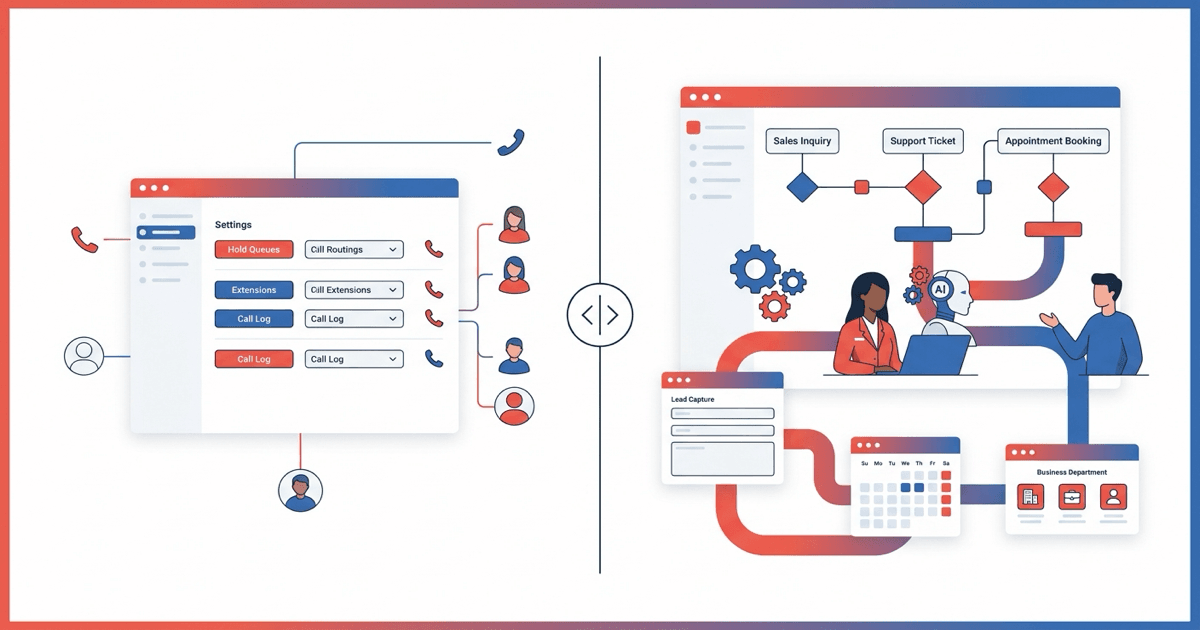
The comparison below reflects what actually matters when an SMB is evaluating whether a built-in platform feature or a managed service will move the needle on inbound lead conversion:
| Feature | RingCentral AI Receptionist | Astucia AI Receptionist |
|---|---|---|
| Setup | Self-configured via admin portal | Done-for-you setup and training |
| Industry-specific training | Generic routing only | Custom scripts per business and industry |
| Lead capture | Voicemail transcription only | Name, contact, intent captured live |
| CRM integration | Manual export / basic API | Automated push to your CRM |
| After-hours availability | 24/7 routing | 24/7 live engagement and lead capture |
| Human oversight and tuning | None included | Ongoing monitoring and optimization |
| Missed-call text back | Requires Workflow Builder setup | Included |
| Pricing model | Per user per month (seat-based) | Flat monthly rate, no per-seat fees |
| Ideal for | Enterprise call routing on RingCentral | SMBs that need to win every inbound call |
In testing with a Chicago HVAC client, inbound calls during evening hours shifted from voicemail-only to fully handled by Astucia's AI — the system collected the caller's name and issue, offered available appointment slots, booked the service estimate, and sent a confirmation text. No staff involvement. That kind of outcome requires more than a routing toggle: it requires an AI trained on the specific workflows that matter for that business.
Which AI Receptionist Should You Choose?
The honest answer is that these two products are built for different problems.
RingCentral AIR is a reasonable choice if your team already runs on RingCentral, your inbound call volume is manageable, and your primary need is call routing and voicemail efficiency. You can turn it on in a day, configure basic rules, and let it run in the background.
Astucia's AI receptionist is the right choice if:
- You miss calls regularly and each missed call represents a lost revenue opportunity
- Your business type — home services, professional services, healthcare, booking-based — requires specific caller handling
- You don't want to spend time configuring, testing, and tuning an AI system yourself
- You need leads captured and pushed to your CRM, not just routed to voicemail
The market for AI-powered phone answering is growing fast, and every major platform is adding AI features as default inclusions. According to HubSpot's State of AI, 78% of SMBs that adopted AI tools in 2025 reported faster response times — but speed only matters if the AI is actually trained to handle your calls correctly. "Included" features are almost always configured for the average business — and the average business is not your business.
If you want to see what a configured, managed AI receptionist looks like in practice, book a free demo and we'll walk you through exactly how it would handle your inbound calls.