Three HVAC companies rank on the same Google results page. One uses a self-serve AI receptionist they configured over a weekend. One uses a traditional answering service. One uses Astucia.
All three get the same call on a Saturday night at 10 PM from a homeowner whose furnace died.
The first company's AI answers but mispronounces the business name, asks for a ZIP code that's already outside their service area, and fails to book — the homeowner hangs up. The second company's answering service puts the caller on hold for 90 seconds, then reads from a generic script. The third company's AI answers instantly, identifies it as an emergency, collects the job details, and sends a dispatch alert.
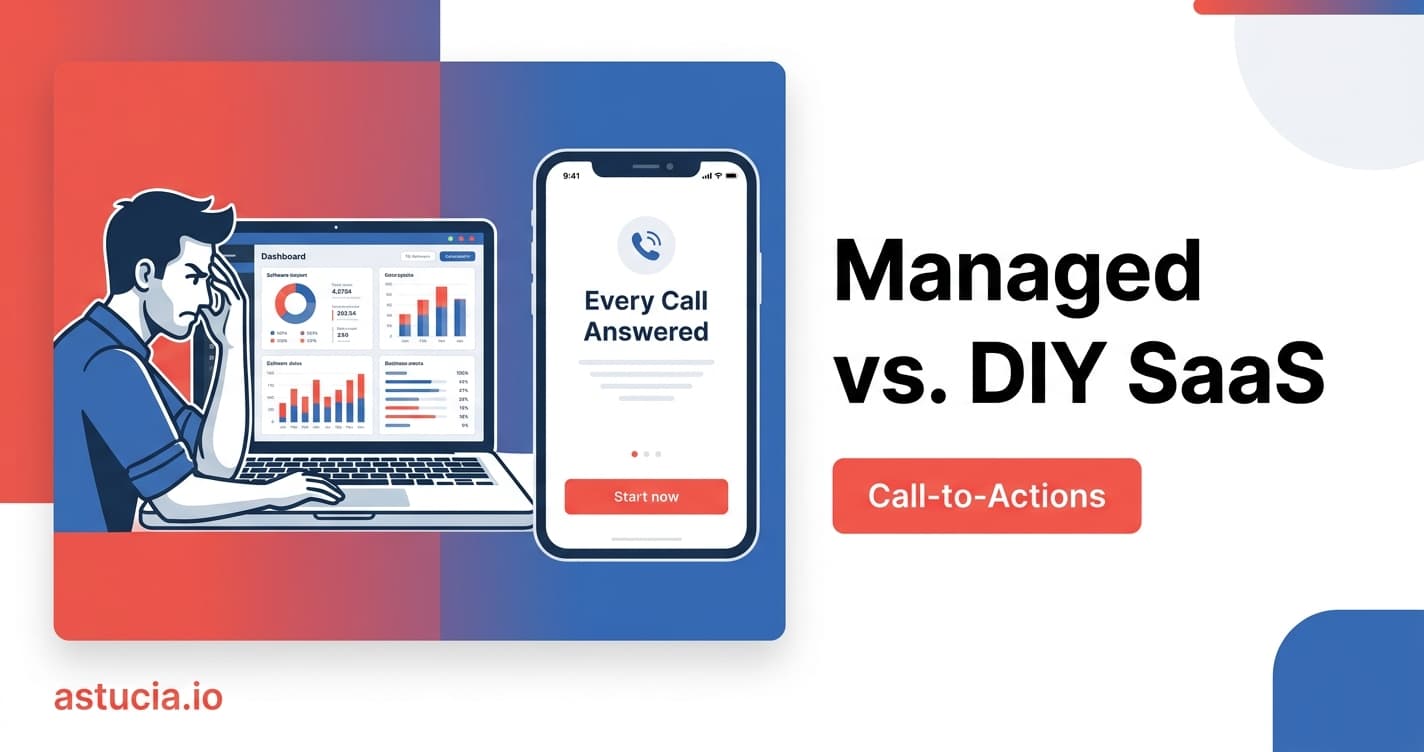
That's the real difference between AI receptionist for home services managed service and DIY SaaS — and why it matters more than the monthly price.
Answer Capsule
A managed AI receptionist for home services is configured, trained, and continuously optimized for your trade by a team that does this full-time. Self-serve SaaS platforms give you the software and leave the setup to you. For HVAC, plumbing, and roofing companies where 62% of calls already go unanswered, the setup quality determines whether you capture jobs or lose them.
The 62% Problem Home Service Companies Keep Ignoring
Before comparing products, it's worth understanding what's actually at stake.
62% of home service calls go unanswered — not because owners don't care, but because the phone system breaks down predictably: lunch breaks, peak-call surges, after-hours, weekends. Research from BIA Advisory Services confirms home service businesses miss the majority of inbound calls during peak periods. A homeowner with a burst pipe at 7 PM does not wait for a callback. They dial the next contractor in their search results.
For an HVAC or plumbing company, a single missed call during a seasonal surge can represent $500–$2,000 in lost revenue. A missed emergency that converts a new customer into a maintenance plan customer is worth $2,000–$5,000 over two years.
The industry's response has been to search for AI receptionist software. That search usually leads to three names: Rosie AI, Goodcall, and My AI Front Desk. All three are self-serve SaaS. None of them solve the actual problem — which isn't access to AI, it's getting the AI working correctly for your specific trade.
Free Resource
Free Call Script Pack
Calculate your missed-call revenue loss and get 12 proven call scripts for AI receptionists.
Download FreeWhat Self-Serve SaaS AI Receptionists Offer
Rosie AI, Goodcall, and My AI Front Desk are all software-as-a-service platforms. You sign up, pay monthly, and configure the system yourself.
Here's what that actually means in practice:
You write the training prompts. The AI needs to know your services, your service area, your pricing structure, your emergency protocols, and your scheduling process. None of that comes pre-loaded. You spend hours writing scripts and testing edge cases — while running a business.
You handle integration. Connecting the AI to your CRM (whether that's ServiceTitan, Housecall Pro, Jobber, or GoHighLevel) requires API configuration. If something breaks, you troubleshoot it.
You monitor call quality. If the AI starts misrouting calls or failing to capture contact information correctly, you catch it by listening to recordings — or by noticing that leads stopped coming in.
You manage updates. When you add a new service, change your service area, or run a seasonal promotion, you update the AI configuration yourself.
For a solo technician who loves software, this might be workable. For an HVAC company owner who is coordinating dispatch, managing technicians, ordering parts, and handling customer complaints, it is another job on top of a full job.
The platforms themselves are capable technology. The gap is that the technology only works as well as the configuration — and configuration requires trade expertise, time, and ongoing attention that most home service owners don't have.
What a Managed AI Receptionist for Home Services Does Differently
A managed AI receptionist for home services flips the model. You don't configure anything. You show up to an intake call, share how your business works, and the AI is ready in five to seven days.
Specifically, what a managed service handles:
Trade-specific training from day one. The AI knows the difference between an emergency (no heat in January, active water leak) and a priority service request (intermittent AC issue in summer). It knows your equipment types, your service area ZIP codes, and how your dispatch process works. That context is built in before the first call.
CRM integration done for you. Every captured lead — name, phone, address, issue description, call timestamp — pushes directly into your CRM. No manual entry. No missed contact details.
Emergency escalation logic configured correctly. True emergencies trigger the right response: immediate call transfer to an on-call technician, SMS dispatch alert, or both — depending on what you need. You set the rules once; the AI enforces them on every call.
Ongoing optimization. Real call data shows where the AI succeeds and where it falls short. A managed service reviews that data and adjusts. A self-serve SaaS platform does not.
Bundled Google Business Profile management. For home service companies, GBP is often the primary inbound source. Managing GBP posts, Q&A responses, and review monitoring alongside the AI receptionist creates a compounding lead capture effect — more calls coming in, all of them answered.
Side-by-Side: Managed Service vs. DIY SaaS
| Feature | Self-Serve SaaS (Rosie, Goodcall, etc.) | Managed Service (Astucia) |
|---|---|---|
| Setup | You configure it | Done-for-you in 5–7 days |
| Trade-specific training | Generic prompts you write | Custom-built for your trade |
| CRM integration | DIY API configuration | Included |
| Emergency escalation logic | You build it | Included |
| Call quality monitoring | Your responsibility | Ongoing review + optimization |
| GBP management | Not included | Bundled |
| Support | Help docs + chat | Dedicated account team |
| Monthly investment | Lower | Higher (significantly better ROI) |
The monthly price difference is real. So is the performance difference. A self-configured AI that fails to capture 40% of leads costs more in lost jobs than the gap in subscription price.
Why the Price Difference Is Worth It for Home Service Companies
Managed services cost more per month. Here is the math that makes it straightforward:
The average booked HVAC service call is worth $250–$500. A converted maintenance agreement customer is worth $1,500–$3,000 per year.
If a properly managed AI receptionist captures three additional service calls per month that would have gone to voicemail, the service pays for itself. If it captures one maintenance agreement customer per quarter, the annual ROI is 3x–6x the monthly cost difference.
The self-serve SaaS alternative is not free. It costs you hours of setup time, ongoing management, and — most importantly — the calls the AI mishandles because the configuration wasn't quite right.
A well-configured AI receptionist for home services also solves a second problem that DIY platforms don't address: consistency. A human receptionist has good days and bad days. A self-configured AI that you set up six months ago and haven't revisited may be routing calls based on outdated logic. A managed system with active monitoring maintains consistent performance as your business evolves.
How Astucia's AI Receptionist Works
Astucia builds and manages AI receptionists specifically for home service companies — HVAC, plumbing, roofing, electrical, cleaning, and related trades.
The process is straightforward:
- Intake call — You explain your services, service area, dispatch process, and any emergency protocols. We handle the rest.
- Custom configuration — We build the AI's knowledge base around your specific business, not a generic home services template.
- Integration setup — Your CRM, scheduling software, and communication channels are connected before you go live.
- Test calls — You review how the AI handles a variety of call scenarios and approve the handling.
- Live in 5–7 days — The AI answers every call from your existing business number. Your customers notice nothing changed except they always reach someone.
After launch, we monitor call recordings, optimize routing logic, and update the AI when your business changes. You focus on the work; the AI captures the leads.
If you want to see exactly how this works for your trade, schedule a 15-minute call with Astucia. We'll walk through your current call handling and show you what the AI would do differently.
Keep Reading
- AI Phone Answering Service: What to Expect — How AI voice systems handle inbound calls for small business
- AI Receptionist vs. Answering Service — Full comparison of your after-hours coverage options
- AI Receptionist for HVAC Emergency Calls — How 24/7 AI answering handles after-hours dispatch
- The Cost of Missed Business Calls — What unanswered calls actually cost home service companies