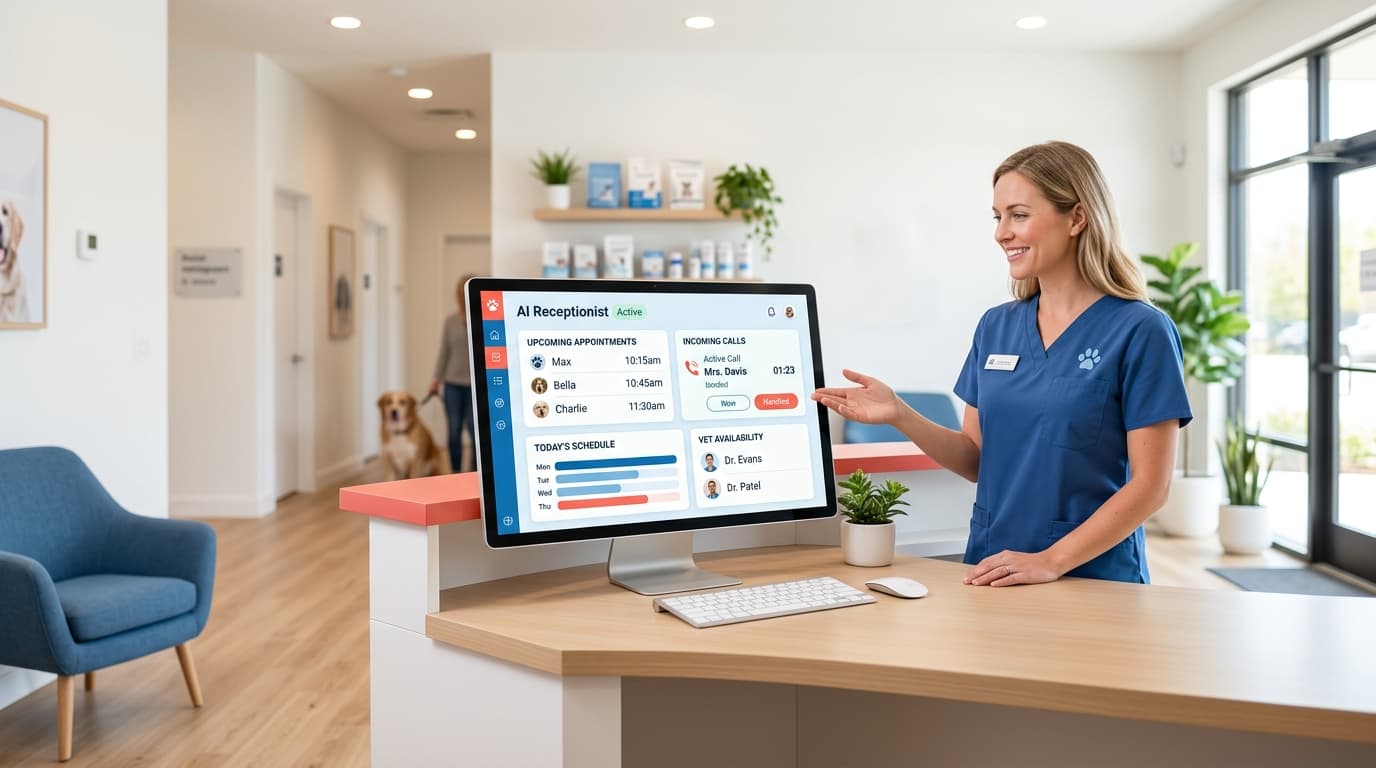
An AI receptionist for veterinary clinics answers every call 24/7, books appointments while your team treats patients, handles after-hours pet emergencies with your custom triage script, and captures every new client lead automatically — turning missed calls into filled appointment slots without adding front desk headcount.
It's 11:14 PM on a Thursday. A first-time pet owner calls your clinic — their dog won't stop vomiting after getting into the trash. They've never been a patient. They're scared. They get voicemail.
They call the next clinic in Google Maps. That clinic answers. That clinic earns a new client.
This scenario plays out dozens of times a week at veterinary practices across the country. According to AVMA workforce data, the average clinic employs 2–4 front desk staff handling 80–150 calls per day — and peak hours, lunch breaks, and evenings create predictable call gaps where patients fall through. The 2024 State of the Veterinary Profession report found that patient acquisition and retention are the top growth challenges for independent practices.
Missing calls isn't a staffing failure — it's a systems gap. An AI receptionist for veterinary clinics closes that gap permanently, handling every inbound inquiry whether your team is in surgery, at lunch, or off for the weekend.
For a full breakdown of what AI receptionists do across service industries, see our Complete Guide to AI Receptionists.
Why Do Veterinary Clinics Miss So Many Calls?
The math is predictable: your phone rings during surgery, during lunch, during the evening, and on weekends. Your front desk staff can only be in one conversation at a time. When call volume exceeds capacity — which happens daily at most practices — calls roll to voicemail.
The problem is that most pet owners hang up rather than leave a voicemail message. They want an answer right now, not a callback in two hours when the problem may have already escalated.
There are three recurring situations that drive missed calls at veterinary clinics:
- Morning and evening rush (7–9 AM and 4–6 PM) when staff are processing check-ins, discharges, and active appointments simultaneously
- Lunch hour when the front desk is closed or running with one person
- After hours, weekends, and holidays when the clinic is physically closed
An AI receptionist for veterinary clinics doesn't take breaks, doesn't go home at 5 PM, and can handle multiple calls simultaneously without putting anyone on hold.
What Can an AI Receptionist Do for a Veterinary Practice?
A purpose-built AI receptionist handles far more than routing calls. When trained on your clinic's specific services, policies, and protocols, it becomes a knowledgeable extension of your front desk — available around the clock.
Appointment scheduling — books new patient exams, wellness visits, vaccine appointments, dental cleanings, and follow-ups directly on your calendar. Sends confirmation and reminder texts automatically.
FAQ handling — answers common questions about your vaccine schedules, heartworm protocols, flea and tick prevention, spay and neuter policies, and hours. Trained on your specific services, not generic scripts.
New patient intake — collects pet name, species, breed, age, owner contact information, and reason for visit. Logs everything to your practice management system or CRM before your team even arrives in the morning.
Prescription refill routing — captures refill requests, verifies the patient is a current client, and queues the request for your veterinary team to review. No more sticky notes and callbacks.
Emergency triage — follows your after-hours protocol precisely. For non-emergencies, offers the next available appointment. For urgent cases, delivers your emergency line number, nearest 24-hour facility address, and key instructions — then logs the full interaction for morning review.
Missed-call text-back — if a caller hangs up before connecting, the system sends a follow-up text within 60 seconds. Across service-based clients, this recovers 30–40% of callers who didn't leave a message.
Free Resource
Free Call Script Pack
Calculate your missed-call revenue loss and get 12 proven call scripts for AI receptionists.
Download FreeHow Does an AI Receptionist Handle Pet Emergencies After Hours?
Emergency protocol is the question practice managers ask first — and rightfully so. A panicked pet owner at midnight needs clear, accurate information fast.
Astucia's AI Receptionist is trained on your custom emergency script. Here's how a typical after-hours emergency call flows:
- Caller describes urgent symptoms
- AI identifies emergency keywords — seizure, difficulty breathing, toxin ingestion, trauma, uncontrolled bleeding, or loss of consciousness
- AI delivers your emergency line number and nearest 24-hour facility, clearly and without filler
- AI logs the caller's name, pet information, symptom description, and call time for your team's review
- Optional follow-up text to the caller with the emergency clinic's address and hours
The AI does not diagnose or advise on treatment. It routes, informs, and logs. Every interaction is recorded so your team can follow up in the morning and convert the emergency caller to a regular patient.
This is the key difference between an AI receptionist for veterinary clinics and a generic answering service: the AI knows your clinic, your emergency contacts, and your exact protocol — not a one-size-fits-all script.
Is an AI Receptionist Worth the Investment for a Vet Clinic?
One new client per month covers the monthly service cost.
The average lifetime value of a veterinary client — factoring in annual wellness visits, vaccines, dental cleanings, and occasional sick visits — can easily run $800 to $1,500 or more depending on practice type and patient mix. A single missed call converted to an ongoing client relationship generates significant return on a flat monthly service fee.
The ROI calculation is direct: how many calls is your current setup missing each week? If the answer is 10 or more, and even 20% of those convert, the numbers work immediately.
In working with booking-based service clients, practices using Astucia's AI receptionist for veterinary clinics-style workflows (after-hours coverage + missed-call text-back) typically recover 3–6 new appointment bookings per month that would otherwise have been lost to voicemail. At a $150+ average appointment value, that pays for the service and then some.
How Do You Set Up an AI Receptionist for a Veterinary Practice?
Most clinics are live in 1–2 weeks. Here's how the onboarding process works:
-
Knowledge base training — your team shares your services, vaccine schedules, medication FAQs, hours, pricing guidelines, and emergency protocol. Astucia builds this into the AI's training so it knows your practice, not just generic vet topics.
-
Call flow design — we map exact conversation paths for appointment booking, FAQ handling, emergency routing, and prescription refill intake. You review and approve before anything goes live.
-
Phone integration — the AI connects to your existing business phone line via call forwarding. No hardware changes, no new numbers unless you want one.
-
Practice management connection — new appointments sync to your calendar system. Patient intake data flows to your CRM or practice software so nothing gets lost between the AI conversation and your records.
-
Testing and launch — your team tests the AI through every call scenario before going live. Most clinics are answering real calls with AI within 10 business days.
Book a quick demo to see how the call flow works for a veterinary practice your size.