An AI receptionist for massage therapists answers every call 24/7, books appointments while you work on a client, sends automated no-show reminders, and handles rescheduling and intake questions without interrupting your session — giving solo practitioners the front-desk coverage they need without the payroll cost of a human hire.
Nearly 70% of massage therapists are self-employed, according to the American Massage Therapy Association. That means the majority of the industry's roughly 355,000 practitioners have zero dedicated front-desk coverage — every call during a session goes to voicemail, and most callers don't wait.
For a full overview of how AI phone answering works across service businesses, see the AI receptionist guide.
What Does an AI Receptionist Do for a Massage Therapist?
A managed AI receptionist for massage therapists takes over front-desk responsibilities so you can stay focused on the client on your table. Core capabilities include:
24/7 call answering: Picks up every inbound call — during sessions, after hours, weekends, and holidays — with a trained voice response. Callers interact with a live system, not a voicemail recording, and complete their booking request in real time.
Direct appointment booking: Integrates with scheduling tools like Mindbody, Jane App, or Square Appointments to book slots directly into your calendar. No manual entry, no callback needed from you.
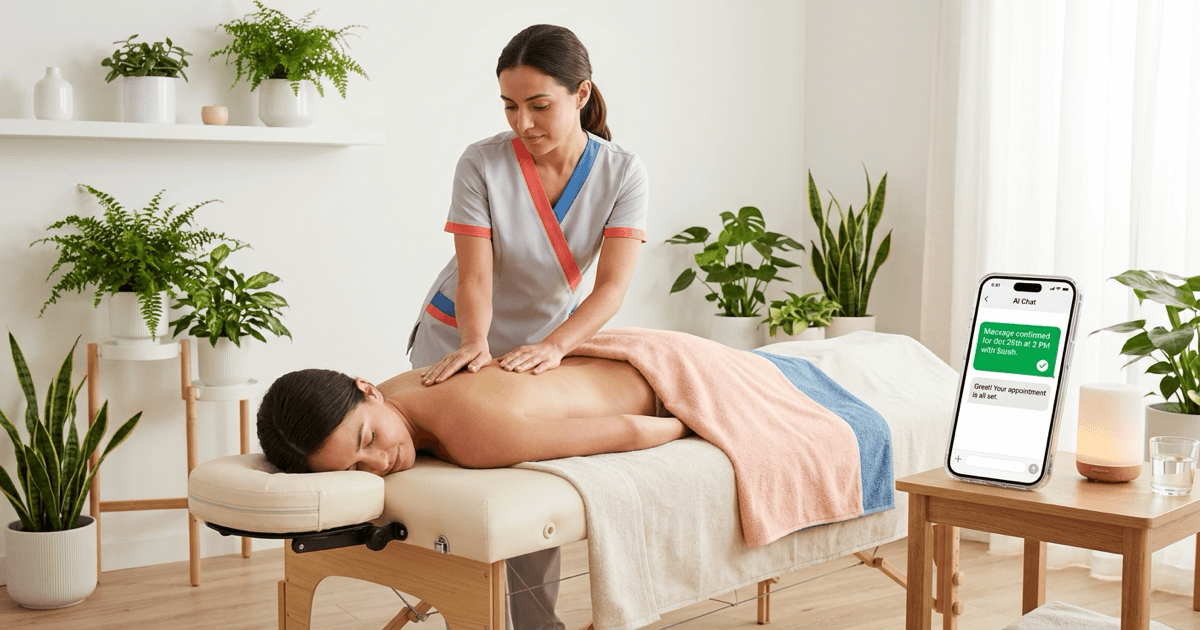
Rescheduling and cancellations: Handles changes on the spot, updates your calendar, and sends the client a confirmation text — without pulling you out of a session.
Intake and FAQ handling: Answers questions about your services, modalities, pricing ranges, location, and intake forms. The AI is trained on your specific offerings so responses are accurate and consistent.
Missed-call text-back: When a caller disconnects before the call connects, the AI sends a follow-up text within 60 seconds — recovering callers who would otherwise search for the next therapist on Google.
The difference from a standard voicemail box is significant. Callers stay in an active conversation, get their questions answered, and complete a booking instead of hanging up and calling a competitor.
Why Do Massage Therapists Lose So Many Bookings by Phone?
The core problem is structural: massage therapy is a hands-on service where the therapist cannot step away from the table. A 60- or 90-minute session means the phone goes unanswered for the entire duration — and call volume spikes exactly when your schedule is most packed.
High-demand call windows for massage therapists cluster at predictable times:
- Midday (11am–1pm): Lunch-break booking calls from office workers scheduling after-work sessions
- Late afternoon (4pm–7pm): Post-work inquiries during your busiest appointment block
- Saturday mornings: The highest-volume window, when clients plan their week-end self-care — and your tables are full
According to the Bureau of Labor Statistics, over 100,000 massage therapists work in the US as independently employed practitioners in non-institutional settings. These practitioners typically handle their own scheduling, marketing, and client communications with no administrative support.
For a solo therapist averaging 25 client sessions per week at a $90 average rate, losing just 15% of unanswered calls translates to roughly $877 in missed weekly revenue — or $45,600 per year — before accounting for repeat booking value.
An AI receptionist for massage therapists is live exactly when you are not — capturing the calls you physically cannot take.
Free Resource
Free Call Script Pack
Calculate your missed-call revenue loss and get 12 proven call scripts for AI receptionists.
Download FreeHow Does an AI Receptionist Handle the 5 Most Common Scenarios?
Here are the five situations where an AI receptionist for massage therapists delivers the clearest return:
Win 1 — Booking calls during active sessions
A new client calls at 2pm while you are mid-session. The AI picks up, answers their questions about your modalities and availability, and books them into your next open slot. By the time your session ends at 3pm, the appointment is already confirmed and a text reminder is queued.
Win 2 — After-hours inquiries from new clients
Most callers search for massage therapists in the evening, after their workday. An AI receptionist answers at 9pm as confidently as at 9am — quoting your availability, explaining your intake process, and completing the booking before the caller decides to check a competitor.
Win 3 — Rescheduling without the back-and-forth
A regular client texts or calls to reschedule. The AI checks your calendar, offers available alternatives, and locks in the new time immediately. You see the update in your scheduling app when the session ends — no voicemail tag, no missed step.
Win 4 — No-show reduction with automated reminders
AI receptionists send appointment reminders via text at 48 hours and again at 2 hours before each session. No-show rates for massage practices that use automated reminders drop measurably — one 2024 survey by Square found that automated reminders reduce no-shows by up to 28% for appointment-based service businesses.
Win 5 — Intake question handling before the first session
New clients often call with questions before booking: Do you do deep tissue? What do I need to bring? Do you work with injury rehabilitation? The AI handles these calls with answers trained on your specific offerings, turning inquiry calls into booked appointments instead of research dead-ends.
In testing with a Chicago-area massage therapy practice, adding AI call answering during peak hours captured 9 unanswered booking calls in the first two weeks — approximately $810 in recovered session revenue at a $90 average rate. The therapist reported that Saturday morning bookings specifically increased within the first week, since that had been the hardest window to cover manually.
How Does AI Reception Compare to a Part-Time Front-Desk Hire?
This comparison comes up often, so here is a direct breakdown.
A part-time receptionist in Chicago runs $17–$22 per hour. At 20 hours per week, that is $1,360–$1,760 per month — covering only scheduled hours, with calls still going to voicemail before opening, after closing, and during the hire's breaks.
An AI receptionist for massage therapists operates around the clock at a flat monthly rate, with no overtime, no sick days, no onboarding time, and no performance management. For a solo or two-therapist practice that generates most of its new bookings by phone, the math is direct: more coverage, lower cost, and no scheduling headaches.
The right fit depends on your practice model. If you run a high-volume multi-therapist studio with existing admin staff, a hybrid approach often makes sense. If you are a solo practitioner or a 2–3 person practice with no front desk, an AI receptionist for massage therapists eliminates the coverage gap entirely.
How Do You Get Started With an AI Receptionist for Your Massage Practice?
Setup for a managed AI receptionist typically takes less than a week. Here is what the onboarding process looks like:
- Provide your service menu and booking rules: The AI is trained on your modalities, session lengths, pricing ranges, intake requirements, and availability windows.
- Connect your scheduling software: Mindbody, Jane App, and Square Appointments all support direct integration for real-time booking.
- Forward your business number: Your existing phone number routes through the AI system. Clients call the same number they always have — nothing changes on their end.
- Review and go live: A brief test phase confirms the AI handles your most common call scenarios accurately before you flip it live.
From that point, the AI handles inbound calls automatically. You review booking confirmations in your scheduling app as usual.
Book a free demo to see how it works with your current setup and get a quote based on your call volume.