A plumber in Oak Lawn ranks in Google Maps for exactly what he does. He gets 60 impressions a month from people actively searching for a plumber. Visitors land on his site.
And then nothing — no call, no form fill, no booking. They leave and hire the next business on the list.
Not because the business is bad. Because the website didn't do enough.
That's the problem an ai powered website small business owners are building to solve right now — a site that works like a 24/7 salesperson, not just a digital brochure that waits for someone to pick up the phone.
What Is an AI-Powered Website for a Small Business?
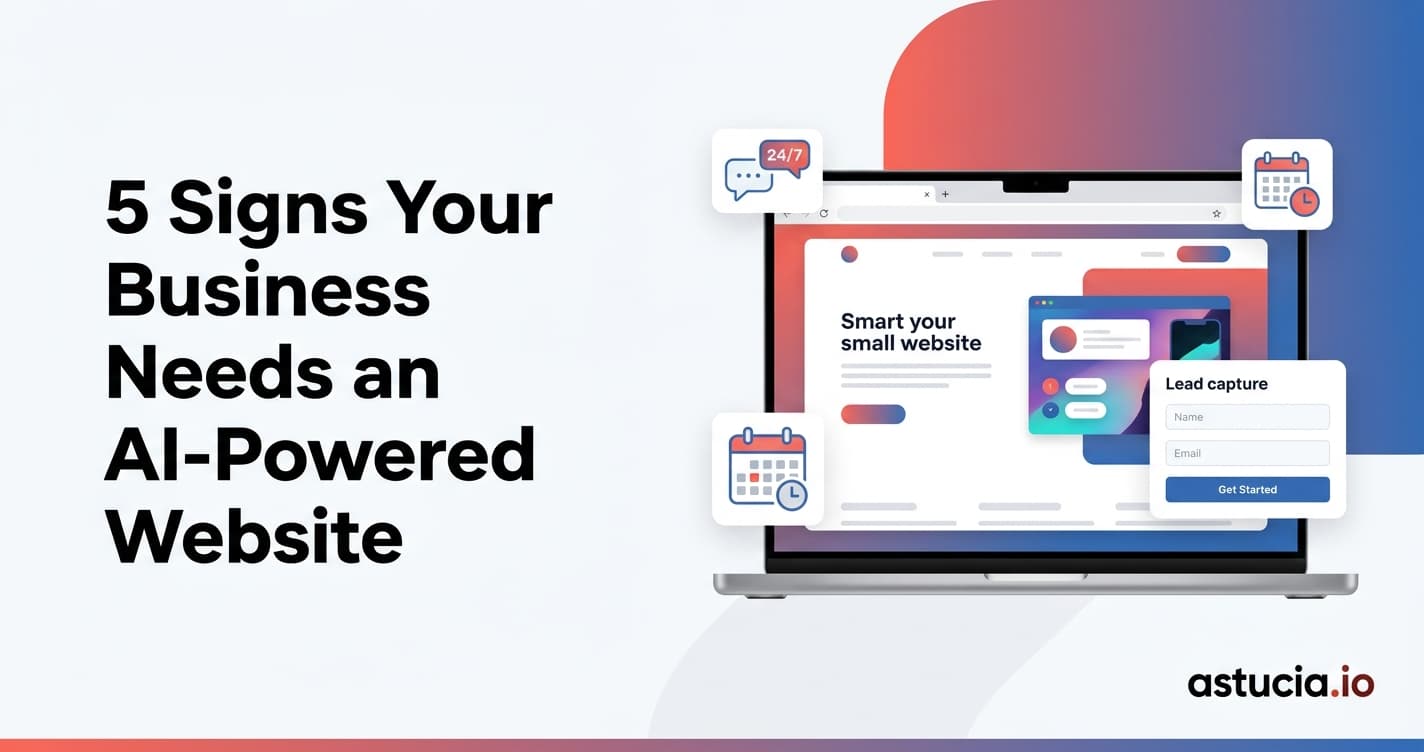
An ai powered website small business owners rely on goes well beyond a static services page. It combines traditional web design with embedded automation — chatbots that answer visitor questions instantly, booking calendars that capture appointments without a phone call, and lead forms that follow up automatically. The result is a site that actively converts visitors into customers even at 2 a.m., when your team is offline.
Most small business websites were built to inform: a homepage, a services page, a contact form, some photos. That was fine in 2018. It's not enough in 2026.
Customers today expect instant answers. According to Salesforce, 83% of consumers expect immediate engagement when they reach out to a business. A contact form that takes 24 hours to get a response doesn't meet that bar — and the visitor moves on to whoever responds first.
An AI-powered site closes that gap by responding the moment someone lands on the page, not the next morning.
Sign 1: Visitors Are Landing But Not Contacting You
If you have any website traffic — from Google, ads, or your Google Business Profile — but very few leads, the problem is almost always on the site itself, not the traffic source.
The average small business website converts less than 2% of visitors into actual leads. That means 98 out of every 100 people who find you online leave without taking any action.
An ai powered website small business owners set up closes this gap by removing the friction between "landing on your site" and "becoming a lead." Instead of asking visitors to hunt for a phone number and call during business hours, an AI chatbot greets them by page context — "Looking for help with HVAC service in Chicago?" — and collects their contact information within 30 seconds.
For service businesses — plumbing, cleaning, legal, dental, roofing — the difference between a 1% and a 4% conversion rate is the difference between one new client a week and four.
Free Resource
Free Lead Audit Checklist
Find the 7 most common reasons your website visitors leave without converting.
Download FreeSign 2: You're Missing Inquiries After Hours
This one is quietly expensive. Most small business owners don't realize how much they're losing because the missed leads never appear in their data.
Research shows that more than half of local service searches happen outside normal business hours — evenings, weekends, early mornings. If your website can't respond at 9 p.m. on a Saturday, those prospects are going to whoever can.
BrightLocal's research on local consumer behavior confirms that speed of response is the single biggest factor in whether a lead converts. The first business to respond wins — not necessarily the best one.
An ai powered website small business owners configure catches after-hours inquiries automatically. The chatbot handles the initial conversation, qualifies the lead ("What area are you in? What's the issue?"), and either books an appointment directly or queues a notification so you can follow up first thing in the morning.
You don't need to hire a night receptionist. You need a site that doesn't go offline at 5 p.m.
Sign 3: Your Team Keeps Answering the Same 10 Questions
Pay attention to your phone calls and emails for one week. If the same 5–10 questions show up repeatedly — pricing, service area, how the process works, what's included — your website isn't doing its job.
Every time a team member answers a routine inquiry by hand, you're paying for that interaction. Phone time, email time, mental load. Across 25 leads a week, that's hours of productive time spent on questions that could be automated.
An AI chatbot handles all of those questions. You build it once, train it on your services and FAQ, and it answers correctly every time — without variation, without mood, without putting someone on hold.
The best ai powered website small business setups go further: they connect the chatbot to your CRM so that when a lead asks a qualifying question, the answer routes them automatically to the right booking page and logs the contact in your pipeline. No manual data entry. No leads falling through the cracks because someone forgot to follow up.
Sign 4: You Can't Tell Where Your Best Leads Come From
Most small business websites have Google Analytics installed. Most owners check it occasionally, see a wall of numbers, and leave without knowing what the data actually means for their revenue.
That's a symptom of a site that wasn't built for lead tracking. When your site has smart lead capture — chatbot conversation logs, tracked form submissions, click-to-call event tagging — you can connect traffic sources to actual leads and see what's working.
Are your best leads coming from organic search? From your Google Business Profile? From a specific blog post you published 4 months ago? You can't know without proper tracking built into the site.
Without this visibility, you guess. You might be paying for ads that drive low-intent browsers while your highest-converting traffic is free organic search you're not nurturing. An AI-powered site gives you the attribution layer to make actual marketing decisions.
Sign 5: Your Competitors Are Getting More Reviews and Outranking You
Google's local algorithm treats review velocity — how often you get new reviews — as a ranking signal. A competitor with 180 reviews at 4.7 stars will consistently outrank a business with 40 reviews at 5.0, everything else being equal.
The businesses pulling ahead in local search aren't doing anything heroic. They've automated review collection.
After a job is completed, the system sends an automated text or email to the customer with a direct link to leave a Google review. No manual follow-up required. No relying on staff to remember to ask. The request goes out while the experience is still fresh.
This creates a compounding advantage. More reviews → higher local rankings → more organic traffic → more customers → more reviews. An ai powered website for small business includes this as part of the standard workflow — not an add-on you have to remember to set up separately.
If your competitors appear above you in the map pack and you can't figure out why, check their review count. It's almost always that straightforward.
What to Do If Three or More of These Signs Apply
If you recognized your business in three or more of these signs, your current site is actively costing you leads and revenue. Not because of bad design — because it wasn't built to compete in 2026.
Getting an ai powered website small business owners can actually rely on doesn't require becoming a tech expert. A good agency handles the build, the AI integrations, the chatbot training, and the review automation — and delivers a site that converts from day one.
At Astucia, we build custom AI-powered websites for service businesses, e-commerce brands, and booking-based businesses. Every site includes a trained chatbot, booking integration, lead capture with CRM sync, and automated review collection — managed end to end.
Book a free 15-minute demo to see what an AI-powered site looks like for your specific industry.