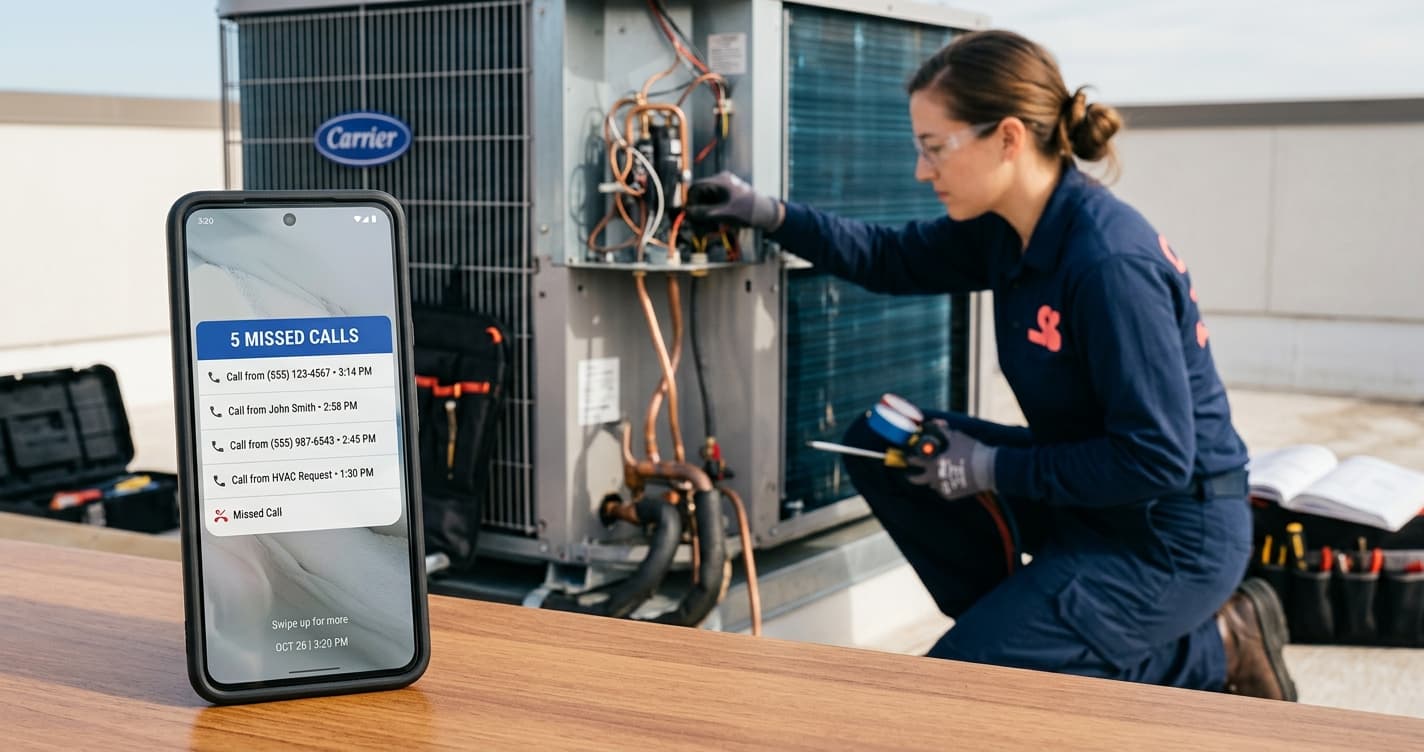
Out of 130,175 contractor calls tracked in a recent industry study, 74.1% went unanswered.
Not a rounding error. Nearly 3 in 4 people who called a home service business — an HVAC company, a plumber, an electrician — reached a voicemail, a busy signal, or no response at all.
If your HVAC business answers half your calls, you're beating the industry average. You're still losing half.
Those missed calls are not random. They cluster around the moments when business is highest — Monday mornings when weekend emergencies pile up, summer afternoons when AC units fail under peak load, and any stretch of extreme weather when call volume doubles in 48 hours. The calls you need to capture most are the ones most likely to go unanswered.
Where the Calls Go
HVAC contractors are not neglecting their phones on purpose. The problem is structural. You have technicians in the field, a dispatcher coordinating schedules, and whoever is in the office handling inbound calls. When the office is busy — a tech calling with a parts question, a customer in the middle of a billing dispute, a service call running long — the next ring goes to voicemail.
Missed calls in HVAC are a systems failure, not a staffing failure. An AI receptionist for HVAC companies eliminates the gap by answering every inbound call the moment it arrives — any time of day. It collects the caller's name, address, equipment type, and issue, then routes the lead to your dispatcher or books the appointment directly. No hold time. No voicemail.
The calls aren't going to voicemail because your team doesn't care. They go to voicemail because your team has finite attention and peak demand exceeds it. That's a systems problem, and AI is a systems fix.
What Each Missed Call Actually Costs
The math is direct. Industry data on HVAC call conversion rates puts the average residential HVAC job between $500 and $900. Emergency calls — a furnace that stopped working in January, an air conditioner that failed during a summer heat advisory — skew toward the higher end because customers need same-day service and will pay for it.
Run those numbers against the industry answer rate. If your business receives 30 inbound calls per week and answers 26% of them, you're handling 8 calls and missing 22. At $650 per average job, those 22 missed calls represent $14,300 in potential weekly revenue that never enters your pipeline.
Over a 12-week peak season, that's more than $170,000.
Most HVAC owners don't think in those terms because missed revenue is invisible. You count jobs you booked. The calls that went to voicemail and never called back leave no record. They don't show up in your weekly report — they're just money that didn't appear.
That invisibility is what makes the problem so easy to underestimate. You'll see a decent revenue month and not realize it would have been significantly better if your answer rate was 70% instead of 26%.
Free Resource
Free Call Script Pack
Calculate your missed-call revenue loss and get 12 proven call scripts for AI receptionists.
Download FreeWhy Peak Season Makes It Worse
HVAC demand is seasonal, and the missed-call problem compounds at exactly the wrong time.
During summer AC season and winter heating season, call volume spikes precisely when your team has the least capacity to respond. Every technician is scheduled. Every dispatch window is booked. The office is managing a full day of service calls, parts orders, and customer follow-ups simultaneously.
Call volume goes up. Answer rate goes down.
There's a second pressure: customers with emergencies don't wait. A homeowner whose air conditioning failed at 2 p.m. on a Saturday is not going to leave a voicemail and check back Monday. They call down the list until someone answers. The first HVAC contractor to pick up gets the job — not necessarily the one with the most experience or the strongest reviews. The one that answered.
That response-speed advantage used to require 24/7 staffing. It no longer does. The technology that used to cost thousands per month to staff is now available as a managed AI service at a fraction of that price.
A third factor worth noting: after-hours demand is larger than most owners assume. Search and call patterns show a significant share of homeowner inquiries come in between 6 and 9 p.m., when offices are typically closed. If your phone goes to voicemail at 5 p.m., you're forfeiting a meaningful chunk of your inbound leads every evening.
How an AI Receptionist for HVAC Companies Changes the Math
An AI receptionist for HVAC companies answers every inbound call immediately — nights, weekends, holidays, and the peak weeks when your office is stretched thin. Response time is zero. Hold time is zero.
The intake conversation mirrors what a trained dispatcher does: confirm the caller's name, get the service address, identify the equipment type and what's happening, and determine urgency. For emergency calls, the AI sends a real-time alert to your on-call technician via text so a human can respond within minutes. For routine service requests, it books the appointment directly into your calendar.
Every call that used to go to voicemail now has a lead record, a service address, and a scheduled next step.
Two additional advantages stand out:
After-hours capture. An AI receptionist running 24/7 captures evening and weekend calls and schedules them overnight. Your dispatcher arrives in the morning with a queue of booked jobs, not a pile of missed voicemails to sort through.
No staffing dependency. Whether one person or three are in the office, the phone gets answered every time. Sick days, turnover, and vacation coverage don't affect your inbound answer rate.
For detail on emergency escalation and after-hours setup, see AI Receptionist for HVAC: Handle Emergency Calls 24/7 Without Staff.
What to Look for When Choosing
Not all AI receptionist for HVAC companies options handle intake the same way. A few questions to confirm before signing up:
Does it connect to your scheduling system? If the AI captures a lead but can't book the appointment, a human still has to close the loop. The value is in the complete handoff — collect the information, assess urgency, and schedule the job in one call.
How does it handle emergencies? Ask specifically: does the system send a real-time SMS to your on-call tech, how fast, and what information does the alert include? A generic "we'll have someone call you back" message isn't emergency handling.
Is it trained on your specific service area? A generic answering script doesn't know your coverage zip codes, your response time policy, or how you handle warranty calls. The AI should be configured for your business, not a default contractor template.
What's the pricing structure? Per-call billing can spike during peak season. A flat monthly rate is more predictable when call volume is highest.
At Astucia, the AI receptionist for HVAC companies we configure for clients handles intake, escalation, and direct booking in a single conversation — at a flat monthly fee that doesn't change based on call volume.
Book a free 15-minute demo to hear how it handles a real HVAC emergency call scenario.