You launch your site on Wix, Squarespace, or an AI website builder. It looks great. The builder calls it "SEO-optimized." You move on.
Three months later, your competitor shows up when someone asks ChatGPT "best HVAC company near me" — and you don't.
That gap has nothing to do with your Google rankings. It's an AI search problem, and your website builder almost certainly didn't mention it.
The Gap Between "SEO-Ready" and Actually Discoverable
Here's what most AI website builder SEO documentation will tell you: they handle meta titles, meta descriptions, auto-generated sitemaps, and clean URLs. All true. All table stakes.
What they won't tell you is that traditional on-page SEO and AI search visibility are two different problems — and AI website builders only solve one of them. In 2026, as ChatGPT, Perplexity, and Google's AI Overviews handle 30–40% of discovery searches, a site that isn't optimized for AI engines is invisible to a growing segment of your potential customers.
This isn't a theoretical risk. It's the reason some small businesses are seeing steady Google traffic while new customer calls plateau — the searchers who would have clicked through to their site are now getting AI-generated answers that don't mention them at all.
What "SEO-Optimized" Actually Means in an AI Website Builder
When a platform markets its AI website builder SEO features, they're referring to a checklist that was industry-standard in 2022:
- Page titles and meta descriptions
- XML sitemap submission
- Canonical tags
- Mobile responsiveness
- SSL certificate
These still matter. But they're not why your competitor is getting cited by Perplexity when a homeowner asks for a local plumber.
AI search engines work differently from Google's traditional crawler. They're looking for sites that answer questions directly and unambiguously — not just sites that contain relevant keywords. The structure of your content, the presence of specific schema markup, and whether you've made your site accessible to AI crawlers all determine whether an AI assistant recommends your business or ignores it.
None of that is covered by standard AI website builder SEO tools.
Free Resource
Free Lead Audit Checklist
Find the 7 most common reasons your website visitors leave without converting.
Download Free5 Things AI Website Builders Miss for SEO
1. Answer Capsules
AI engines like ChatGPT and Perplexity scan web pages looking for direct, quotable answers to queries. A well-structured page places a concise 40–60 word answer near the top — right after the first major heading — so AI crawlers can extract and cite it.
AI website builders don't generate this structure. They produce visually appealing layouts, not answer-optimized content hierarchies.
2. FAQ Schema Markup
FAQ structured data tells both Google and AI crawlers that specific question-and-answer pairs exist on your page. Google uses it to generate rich results. AI engines use it to surface your business in conversational queries.
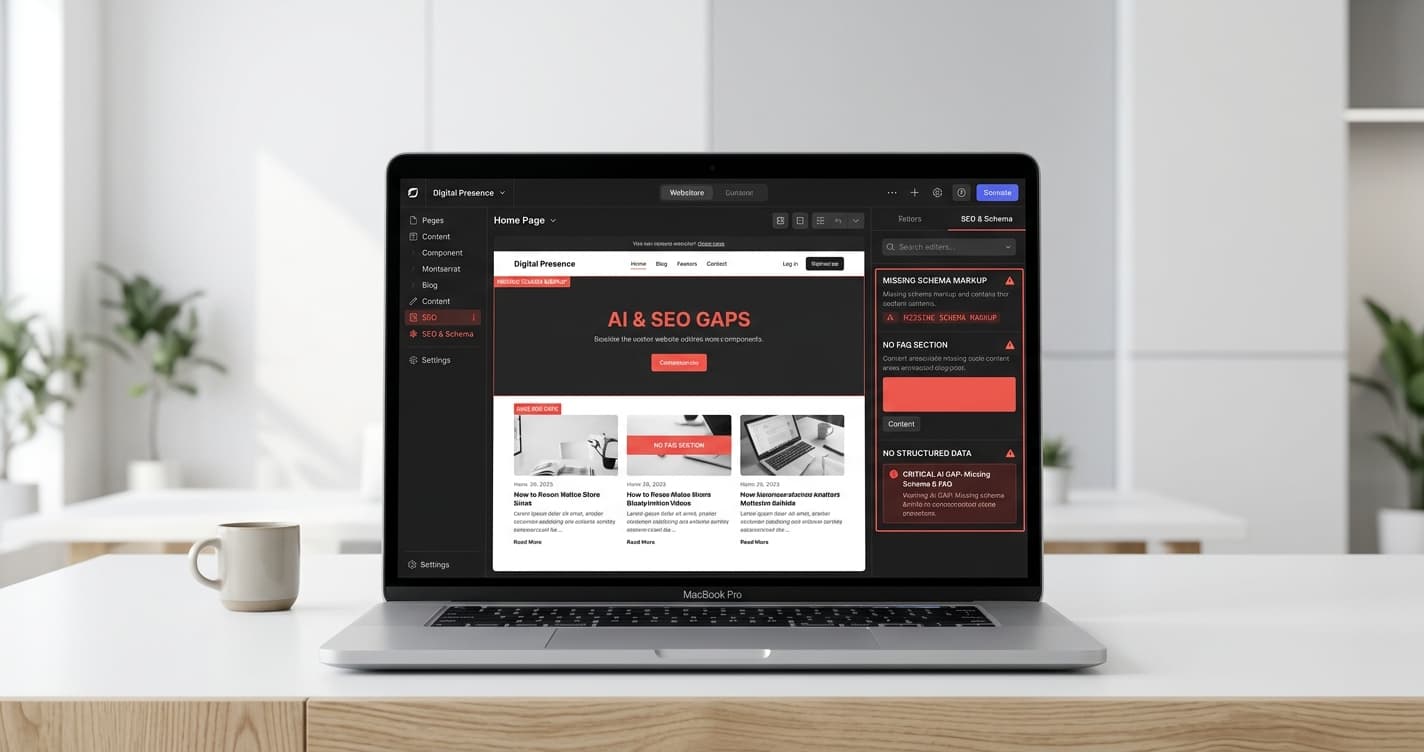
Most AI website builders don't support custom JSON-LD structured data injection. Even the ones that do typically don't include FAQ schema in their SEO feature set.
3. An llms.txt File
An llms.txt file is a relatively new convention — similar to robots.txt, but specifically for large language models. It tells AI crawlers what your site is about, what pages to prioritize, and how to understand your business context.
No major AI website builder generates or prompts you to create one. This means AI crawlers parsing your site have to infer your business identity instead of reading a clear declaration — and they often get it wrong.
4. Entity Consistency and Schema Markup
AI search engines build a knowledge graph of entities — businesses, services, locations, people. Your website's authority in that graph depends on consistent entity signals: your business name spelled the same way on every page, structured LocalBusiness or Service schema, consistent NAP (name, address, phone).
AI website builder SEO doesn't audit or enforce entity consistency. And they typically don't inject LocalBusiness or Service schema unless you're paying for a higher tier and manually configuring it.
5. Semantic Internal Linking
Traditional SEO internal linking helps Google understand site hierarchy. Semantic internal linking — connecting pages around topic clusters — helps AI engines understand the depth of your expertise in a given area.
An AI website builder creates internal links based on navigation structure and templates. It doesn't build semantic relationships between your service pages, blog posts, and location pages that signal to AI engines: this business is the authority on this topic.
What a Properly Optimized Business Website Needs in 2026
If you're a small business competing for AI search visibility — and you should be — your site needs:
Content structure: Every key page should have a clear, direct answer to the primary question it addresses. No burying the lede. The answer comes first.
FAQ schema on every service page and blog post: At minimum, 3–5 structured FAQ pairs per page that answer the questions your customers actually type into AI assistants.
An llms.txt file: A machine-readable declaration of what your business does, where you operate, and what pages matter most to AI crawlers.
LocalBusiness and Service schema: Properly structured JSON-LD that gives AI engines your business identity, service list, geographic coverage, and operating hours in a format they can use without guessing.
Semantic topic clusters: Blog content organized around pillar topics, with consistent internal linking that demonstrates expertise depth — not just keyword coverage.
None of this is built into the AI website builder SEO feature set, because none of it existed as a standard requirement when these platforms were architected. They were built to rank on Google. AI search is a different game.
The Real Cost of Ignoring AI Search Visibility
The risk isn't that your Google rankings will drop. It's that you'll hold steady in Google while the volume of AI-assisted discovery queries increases — and your business won't appear in any of them.
According to BrightEdge's 2025 AI search research, AI Overviews and AI-powered answer features now appear for a significant share of informational and local service queries. That number is growing. The businesses getting cited in those overviews aren't the ones with the most beautiful websites. They're the ones with properly structured content that AI engines can actually parse and trust.
Your AI website builder SEO score being "100" doesn't mean you're visible where discovery is happening in 2026.
The Bottom Line for Your Business Website
AI website builders are convenient, affordable, and good enough for businesses that aren't competing aggressively for local customers online. If your main channel is referrals and you just need a professional web presence, they do the job.
But if you're trying to generate consistent inbound leads from search — including the growing share of searches happening through AI assistants — the AI website builder SEO limitations outlined above will eventually cap your visibility.
A properly built site with structured AEO, FAQ schema, an llms.txt file, entity markup, and semantic content architecture will outperform an AI website builder template in AI search. Not because it's flashier, but because it's built to be understood by the engines that are increasingly deciding which businesses get recommended.
If you're not sure whether your current site is optimized for AI search, the short test is simple: ask ChatGPT or Perplexity what the best [your service] company in [your city] is. If you're not mentioned, your site has an AI search visibility problem — and no AI website builder feature is going to fix it automatically.