Running a Home Service Business Is a Constant Balancing Act
Every HVAC tech, plumber, roofer, cleaner, or electrician knows the tension: you built this business to do the work, not sit by the phone. But the phone is where the revenue lives. A homeowner's furnace fails at 7 PM on a January night. A pipe bursts on a Sunday morning. A property manager needs a last-minute cleaning before a new tenant arrives. These are high-urgency, high-value calls — and they don't arrive on a schedule that respects your own.
Home service businesses face a unique set of growth challenges that most marketing advice simply ignores. Demand is seasonal and unpredictable. Competition is intensely local — your real competitor isn't a national brand, it's the other HVAC company three zip codes over with a Google rating half a point higher than yours. And your team is in the field, not in an office, which means every missed call during a job is a potential customer handed directly to that competitor.
This playbook covers the four pillars every home service business needs to build a durable, technology-backed growth system: AI-powered call answering, intelligent lead capture, local SEO dominance, and a reputation engine that turns every completed job into new business. Each section is grounded in the real operational patterns of service businesses — not generic advice.
The Missed Call Problem: Where Home Service Revenue Goes to Die
Here is the uncomfortable truth about home service businesses: the phone is your primary sales channel, and most businesses are systematically losing a significant portion of their inbound calls.
Consider a typical weekday for a two-truck HVAC company. Both techs are on jobs — one doing a furnace tune-up, one troubleshooting a refrigerant leak. The office line rings. Nobody answers. The homeowner with an air conditioner that stopped working this morning doesn't leave a voicemail. They call the next company on the list.
This scenario plays out dozens of times per week across the home services industry. Industry research suggests that 62% of calls to small businesses go unanswered. For home service businesses specifically, where customers are often in active distress — no heat, a leak, a broken appliance — the missed call rate translates almost directly to lost revenue.
The True Cost of a Missed Call
To understand what this costs you, work backward from your average job value. If your average HVAC service call is worth $350 and your average replacement or installation job closes at $6,000, a single missed call to a homeowner who needs a new furnace is worth thousands of dollars — not just the job itself, but the lifetime value of that customer (annual tune-ups, referrals, repeat service calls over years of ownership).
Missed call math for a mid-size home service business:
| Metric | Estimate |
|---|---|
| Inbound calls per week | 80 |
| Calls missed (62%) | ~50 |
| Calls where homeowner calls another company | ~35 |
| Average job value | $400 |
| Weekly revenue lost to missed calls | ~$14,000 |
That's not a marketing problem. That's an operations problem — and it has a direct operational fix.
Why Voicemail Doesn't Solve It
The instinct is to set up a voicemail. But voicemail has an extraordinarily low conversion rate for distressed home service customers. A homeowner with no heat in February is not going to leave a message and wait hours for a callback. They're going to call the next number. For non-emergency inquiries — quote requests, scheduling questions, maintenance plan inquiries — voicemail creates friction and delay that erodes customer confidence before the relationship has even started.
The deeper issue is that voicemail puts the burden back on you: someone has to check it, transcribe information, and return the call, often playing phone tag for days. This is operational drag that doesn't scale.
For a detailed breakdown of what missed calls actually cost home service businesses, see our analysis: The Real Cost of a Missed Business Call.
AI Receptionist for Home Services: 24/7 Coverage Without the Overhead
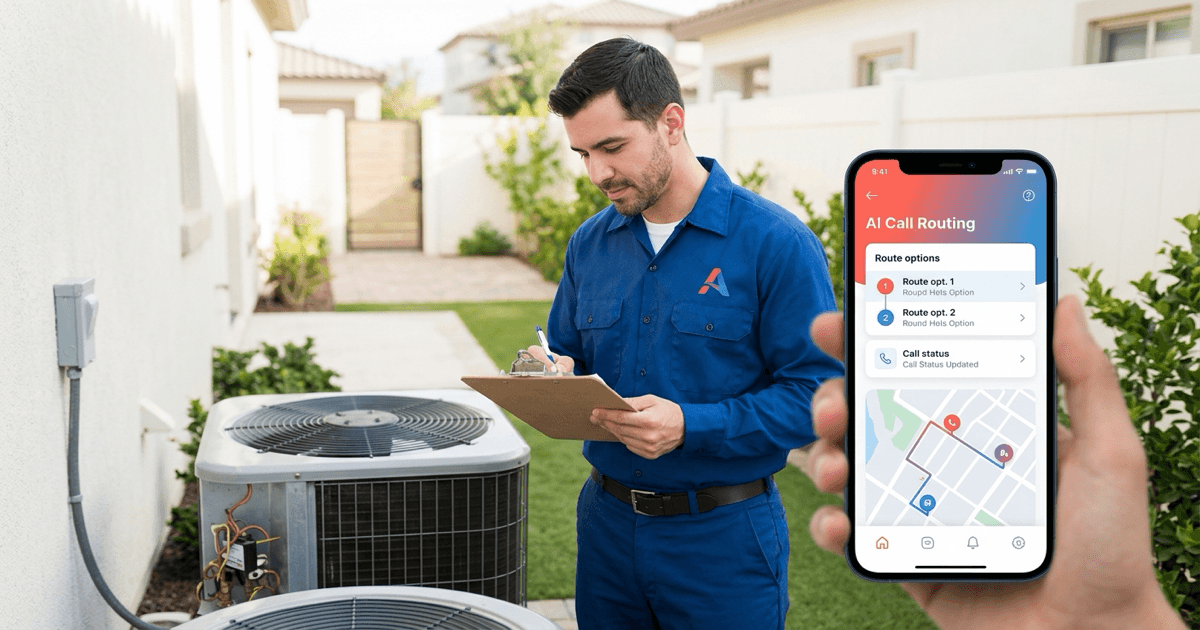
The solution to the missed call problem is not hiring a full-time receptionist (though many businesses eventually do both). It's deploying an AI receptionist that handles every inbound call at any hour — including the ones your team is too busy to answer.
An AI receptionist built for home services is not a basic IVR system that says "Press 1 for HVAC, Press 2 for Plumbing." It's a conversational AI that understands the context of home service inquiries, collects the right information, and routes or escalates based on urgency.
What an AI Receptionist Does on a Home Service Call
When a homeowner calls your HVAC company at 10 PM because their furnace stopped working, an AI receptionist can:
- Greet them by your company name with a natural, professional voice
- Identify the nature of the call — emergency service versus scheduled maintenance versus billing question
- Collect key information: name, address, service needed, urgency level, preferred callback time
- Route emergency calls to your on-call technician via SMS or direct transfer
- Confirm the appointment or callback with an automated text message
- Log the interaction to your CRM so nothing falls through the cracks
For non-emergency calls — quote requests, tune-up scheduling, questions about service plans — the AI handles the entire intake and creates a job ticket, which your team picks up the next morning.
Dispatching and Emergency Routing
Emergency routing is where AI receptionists deliver the most immediate ROI for home service businesses. You define the rules: what counts as an emergency (no heat, active leak, electrical hazard), who gets contacted, and in what order. The AI applies those rules consistently at 2 AM on a holiday weekend with the same reliability as during business hours.
This matters because after-hours emergency calls are often your highest-value jobs. A homeowner who needs a furnace replaced in January is willing to pay premium pricing for fast response. If you answer that call and your competitor's voicemail picks up, you win the job.
Missed-Call Text Back
A critical feature for home service businesses is automatic missed-call text back. If a call does slip through — a network glitch, a simultaneous call situation — the AI immediately sends the caller a text message acknowledging their call and inviting them to reply with their service need or preferred callback time. This single feature recovers a meaningful percentage of calls that would otherwise be lost permanently.
"Most home service businesses don't realize how many jobs they're losing to unanswered calls until they see the data. An AI receptionist doesn't just answer phones — it captures revenue that was already walking out the door."
For a broader look at how AI phone answering works, see AI Phone Answering Service: How It Works. For cleaning companies specifically, see Answering Service for Cleaning Companies.
AI Chatbot for Home Services: Capturing Leads While You Sleep
Phone calls are the primary channel for urgent home service inquiries. But your website is working around the clock for a different kind of prospect: the homeowner researching options before they have an emergency, comparing quotes, or deciding which cleaning service to book for a recurring contract.
These website visitors don't call. They browse, they read, and if the experience is frictionless enough, they book. If it's not — if there's no way to get a quick answer or request a quote — they click back to Google and try the next result.
An AI chatbot turns your website from a digital brochure into an active lead capture system.
What a Home Services Chatbot Handles
A properly configured chatbot for a home service business can handle a wide range of interactions without human intervention:
- Service inquiries: "Do you service Lennox units?" / "Do you offer same-day plumbing repairs?"
- Service area qualification: "Do you serve [zip code]?" — the chatbot checks against your service area and either confirms coverage or collects the lead for follow-up
- Quote requests: Collects job details, property type, scope of work, and routes to your estimating workflow
- Booking: Integrates with your scheduling software to show available slots and confirm appointments
- Financing or payment questions: Provides information about your payment options without requiring a call
- After-hours lead capture: Collects contact information and service details from visitors who arrive when your office is closed
Why This Matters for Seasonal Businesses
Home service businesses are seasonally volatile. During peak HVAC season (late spring for AC tune-ups, early fall for heating checks), call volume can spike 3-5x. Your team cannot scale proportionally — you can't hire a receptionist for three months and let them go when it slows down.
An AI chatbot handles this volume surge automatically. It qualifies every lead, captures the information your team needs to follow up effectively, and ensures that no one who visits your website during a peak period is turned away with a dead end.
Key insight: Home service leads captured by chat convert at a significantly higher rate than cold outbound leads because the prospect has already expressed active interest. Every website visitor who leaves without providing contact information is a warm lead you didn't capture.
Proactive Engagement
Modern AI chatbots don't just sit and wait. They can be configured to proactively engage visitors based on behavior — for example, surfacing a chat prompt when a visitor has been on the "AC Repair" page for 30 seconds, or offering a seasonal discount popup to returning visitors. This proactive approach consistently increases lead capture rates compared to passive contact forms.
For industry-specific guidance, see AI Chatbot for HVAC Companies, Best AI Chatbot for Home Services, and AI Booking for Cleaning Companies.
Local SEO for Home Services: Winning the Zip Codes That Matter
Every home service job is local. You can have the best HVAC technicians in the country, but if a homeowner in your service area can't find you on Google, you don't exist to them. Local SEO is the long-term infrastructure that makes every other marketing investment more effective — it's the difference between paying for every lead through ads and earning a steady flow of organic calls from homeowners actively searching for your services.
Google Business Profile: Your Most Important Local Asset
For home service businesses, your Google Business Profile (GBP) is more important than your website for most local searches. It's what powers the map pack — the three businesses that appear at the top of Google search results with star ratings, phone numbers, and directions.
A fully optimized GBP for a home service business includes:
- Accurate service categories (HVAC contractor, plumber, roofing contractor — be specific)
- Complete service list with descriptions, including seasonal services (AC tune-up, furnace inspection, etc.)
- Service area properly defined — not just your city, but the surrounding zip codes and suburbs you actively serve
- Business hours including emergency / after-hours availability
- Photos: trucks, team members, completed jobs, before/after work
- Weekly posts maintaining activity signals that Google uses to rank active businesses higher
- Response to every review — both positive and negative
The businesses that dominate the map pack in competitive home service markets are not there by accident. They post consistently, respond to reviews within hours, and keep their profile information current through seasonal changes.
Service Area Pages: Ranking for Every Neighborhood You Serve
Beyond GBP, local SEO for home service businesses requires dedicated service area pages on your website. A single "We serve the Chicagoland area" paragraph on your homepage will not rank for searches like "plumber Oak Lawn IL" or "HVAC repair Orland Park." Each significant market in your service area needs its own page with:
- Locally relevant content (specific to that city or neighborhood)
- Clear service offerings for that area
- Embedded Google Map
- Local phone number or tracking number if you use them
- Customer reviews or testimonials from that specific area
These pages compound over time. A business with 20 well-optimized service area pages has 20 separate opportunities to appear on the first page of Google — one for each city or neighborhood they serve.
Review Velocity and Local Rankings
Google's local ranking algorithm weighs review velocity — how frequently you receive new reviews — heavily in determining map pack placement. A business with 200 reviews accumulated over five years will often rank lower than a business with 80 reviews earned in the last 12 months. Recency signals active, trusted businesses.
This is why review automation (covered in the next section) is inseparable from local SEO strategy. Every completed job is an opportunity to add a fresh review signal to your profile.
For a comprehensive local SEO checklist tailored to home services, see Local SEO Checklist for Home Services. For electricians specifically, see Local SEO for Electricians.
Review Automation for Home Services: Turning Every Job Into a Trust Signal
In home services, trust is everything. A homeowner is letting a stranger into their house to work on systems that affect their family's safety and comfort. Before they call, they read reviews. 92% of consumers read online reviews before making a local service purchase, and the average consumer reads at least ten reviews before forming an opinion about a business.
The challenge is that satisfied customers are dramatically less likely to leave reviews than dissatisfied ones — unless you ask. And asking consistently, at the right moment, in the right way, is something most service businesses do sporadically at best.
The Post-Service Review Window
The optimal moment to request a review is within two hours of a completed service call, while the experience is fresh and the customer is in a positive emotional state (their problem is solved, their home is comfortable again). A text message at this moment — personalized with the tech's name and the specific job performed — converts to a review at a dramatically higher rate than a generic email sent days later.
Review automation handles this automatically: the job is marked complete in your system, a personalized review request goes out via SMS, and the customer is directed to your Google Business Profile with one tap. No manual follow-up required.
Handling Negative Feedback
Automated review systems can also include a satisfaction check before directing customers to Google. If the customer indicates they were not fully satisfied, the system routes them to a private feedback form instead of a public review — giving you the opportunity to resolve the issue before it becomes a one-star post.
This "feedback first" approach does not suppress legitimate reviews. It gives dissatisfied customers a fast, easy channel to reach you directly, which most prefer over going to Google. The ones who had a genuinely bad experience may still post publicly — but you've reduced the probability significantly.
The Compounding Effect
A business that captures two to three reviews per week will accumulate 100-150 new reviews per year. Over two years, that's a profile that signals to both Google and prospective customers that this is a high-volume, trusted, actively operating business. Combined with strong GBP optimization and local SEO, this review velocity is often the deciding factor in map pack ranking.
For industry-specific examples, see Google Reviews for Roofing Companies and How to Automate Google Reviews.
Website Design for Home Services: Built to Convert, Not Just Look Good
Your website has one primary job: turn visitors into leads. For a home service business, that means making it frictionless for a homeowner to call you, request a quote, or book a service — from any device, in 30 seconds or less.
The Home Services Website Conversion Stack
The highest-converting home service websites share a common architecture:
- Phone number in the header, visible on mobile without scrolling — this is the single most impactful conversion element
- Service pages for each core offering (not a single "services" page with a list)
- Clear service area information so visitors immediately know you serve their neighborhood
- Online booking or quote request form that takes under two minutes to complete
- Social proof above the fold — star rating, review count, years in business
- Trust signals: licensing information, insurance confirmation, brand affiliations (Carrier dealer, Rheem certified, etc.)
- Speed: Google's research shows that 53% of mobile visitors abandon a page that takes longer than 3 seconds to load. Home service customers on mobile, looking for a plumber with a burst pipe, will not wait.
Mobile-First Is Non-Negotiable
The majority of home service searches happen on mobile, often in urgent situations. A website that looks professional on a desktop but is difficult to navigate on a phone loses those leads immediately. Every element of a home service website — forms, click-to-call buttons, service area maps, photo galleries — must be optimized for a mobile user with one hand free and a problem that needs solving now.
For a detailed look at conversion-focused website design for home services, see Plumbing Company Website Design: What Actually Converts.
Getting Started: Building Your Home Service Growth System
The businesses that grow most effectively in home services are not necessarily the ones with the largest crews or the most trucks. They're the ones who capture a higher percentage of the leads that come their way and convert them more consistently.
An AI-powered growth system — call answering, chatbot lead capture, local SEO, and review automation — does not replace your team. It removes the operational bottlenecks that cause leads to slip through: the unanswered call at 8 PM, the website visitor who couldn't find a phone number, the satisfied customer who never left a review because nobody asked.
The best time to build this system is before your busy season. The second best time is now.
Ready to see how Astucia's AI tools fit your home service business? Walk through your current lead flow with our team and we'll show you exactly where calls and leads are being lost — and how to recover them.