An AI receptionist for tattoo shops answers every call while artists are mid-session, qualifies new design inquiries, books consultations and deposit slots 24/7, and handles multi-artist scheduling. Astucia's phone answering captures after-hours booking requests Chicago studios previously lost to voicemail — a single sleeve consultation typically covers the monthly service cost.
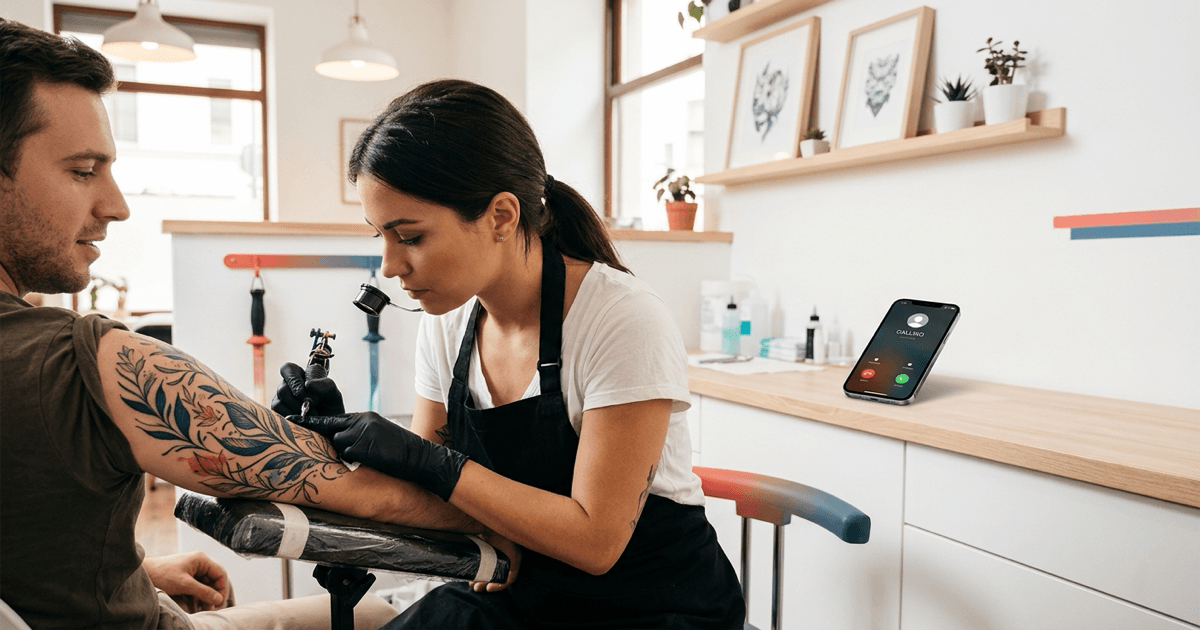
Tattoo studios run on creative focus. When an artist is three hours into a back piece, answering the phone is not an option. But the calls coming in during that session — first-time clients asking about custom work, existing clients wanting to add a session, impulse inquiries from someone who just saw your Instagram post — are the bookings that fill your calendar. They call once. If no one answers, most move to the next shop.
For a full overview of how AI phone answering works across service businesses, see the Complete Guide to AI Receptionists. The five wins below are specific to tattoo studios.
| Managed AI Receptionist | Self-Serve Bot | Human Front Desk | |
|---|---|---|---|
| Available 24/7 | Yes | Yes | No |
| Setup | Done-for-you | Hours of configuration | Hiring and training |
| Custom tattoo FAQ | Yes — trained on your shop | Generic responses | Yes |
| Multi-artist routing | Yes | Limited | Yes |
| Monthly cost | Service fee | $30–100/mo | $3,000+/mo |
| Best for | Active studios, solo artists | Tech-savvy owners | High-volume shops |
Why Do Tattoo Shops Miss So Many Booking Calls?
The tattooing process demands total concentration. A fine-line portrait, a geometric sleeve, a detailed black-and-grey piece — these require hours of uninterrupted work. A professional tattoo artist cannot step away to answer a phone mid-session without compromising quality and the client experience on the table.
Most independent studios and small shops operate with one to four artists and minimal front-desk infrastructure. According to Harris Poll research, approximately 32% of American adults now have at least one tattoo — a market that has expanded steadily over the past decade and drives consistent inbound call volume to neighborhood studios. That demand is real. The gap is in availability.
The highest-value calls cluster at the worst times: weekend afternoons, weekday evenings after 5 PM, and Saturday mornings. A prospective client scrolling through an artist's portfolio at 9 PM on a Friday calls the shop. No one answers. They move on. The studio never knew the opportunity was there.
1. Can an AI Receptionist Answer Calls During Active Sessions?
Yes — and this is where the immediate ROI is clearest. An AI receptionist for tattoo shops operates as a separate answering layer on your business line. When a client calls, the AI picks up immediately, regardless of whether all artists are mid-session, the shop is between clients, or it is two hours after closing.
The AI provides a knowledgeable, professional response every time. It knows your shop's name, location, hours, artists, styles, and booking process. A caller asking about custom sleeve availability gets an accurate, conversational answer — not a voicemail prompt — and can move directly into the consultation booking process during the same call.
For tattoo studios where each booked session represents $200 to $1,500 or more in revenue, recovering even two missed calls per week changes the monthly math significantly. The AI does not get distracted, does not call in sick, and does not miss a call because everyone is focused on the work in the chair.
Free Resource
Free Call Script Pack
Calculate your missed-call revenue loss and get 12 proven call scripts for AI receptionists.
Download Free2. How Does an AI Receptionist Qualify Custom Design Inquiries?
Custom tattoo inquiries require more than a booking link. A caller asking about a full back piece needs specific information: whether your artists require a consultation before quoting, your deposit structure, how far out they are booked, and which artist in your shop handles their style best.
Your AI receptionist is trained specifically on this. When a caller asks about a black-and-grey realism piece, the AI explains your consultation process, the deposit requirement, the artist's current availability for that style, and what to expect from the first appointment. It qualifies the client and — when they are ready — schedules the consult or captures a deposit appointment.
This pre-qualification serves both sides. Serious clients get a fast, informative response and a clear next step. Price-shoppers or low-intent callers end the call without consuming appointment slots on your calendar. The AI handles every inquiry the same way and lets the client self-select into the booking flow.
3. Can the AI Book Consultations and Deposit Slots Automatically?
Yes. Integrated with scheduling tools like Acuity Scheduling or Calendly, the AI reads your live calendar and books the appropriate next step based on your workflow.
For shops that require an in-person or video consultation before large pieces, the AI schedules that slot. For shops that use a deposit to hold artist time, it walks the caller through your process and books the deposit appointment directly. Either way, the confirmed appointment lands in your calendar with the caller's name, contact information, and a summary of what they want — ready for your review before the visit.
HubSpot research on response speed consistently shows that the fastest-responding business wins the booking in competitive local markets. When your AI picks up at 10 PM and books a consultation on the spot, you win that comparison without trying.
4. How Does a Tattoo Shop AI Handle Multi-Artist Scheduling?
Multi-artist shops face a specific routing challenge. A caller who wants a watercolor piece should reach the artist who specializes in that style. A caller asking for a cover-up should be connected to the artist with cover-up experience and current availability. Getting this wrong — or leaving the caller to figure it out — costs a booking.
A managed AI receptionist for tattoo shops is trained on each artist's schedule, style specializations, and booking constraints. When a caller describes what they want, the AI routes them to the right artist's calendar. If that artist is fully booked, the AI notes the timeline and offers the next available window or adds the caller to a waitlist, depending on your workflow.
This removes the coordination overhead from artists entirely. No one has to step out of a session to figure out who should take a call and transfer it. The AI handles the routing decision and delivers a qualified client to the correct booking slot.
5. Can an AI Receptionist Capture After-Hours Walk-In Requests?
Walk-in availability is one of the highest-conversion offers a tattoo studio can make — and one of the hardest to communicate over the phone. A client calls on a Tuesday afternoon asking about same-day flash availability. Nobody picks up. They walk into a different shop.
An AI receptionist handles these calls with the same reliability as a formal consultation booking. It knows your walk-in policy, your flash availability if you update it, and which artists are open for same-day work. It captures the caller's interest and gives them a clear answer and next step — in under two minutes.
After-hours requests follow the same logic. A client who calls Saturday evening to ask about Sunday availability gets an immediate answer and a confirmation rather than a voicemail they will forget by morning. Across booking-based businesses Astucia works with, a meaningful portion of confirmed appointments originate from calls placed outside standard studio hours — and most of those callers would not have left a message.
Is a Managed AI Receptionist the Right Fit for Your Tattoo Shop?
An AI receptionist for tattoo shops works best when your studio:
- Has artists booked into long sessions where phone interruptions are not realistic
- Receives a consistent volume of inquiry calls — even 5–10 per week is enough for a clear return
- Uses a structured booking process (consultation, deposit, or waitlist) that can be explained consistently
- Wants to capture after-hours and weekend calls without adding front desk headcount
It matters less if your studio runs entirely on walk-ins with no structured booking process, or if your entire client acquisition flows through Instagram DMs or direct referrals that never involve an inbound call.
For most working tattoo artists and independent studios, the math is direct. A single missed sleeve consultation represents the entire monthly cost of AI phone answering, often several times over. Every call that goes to voicemail instead of a booked appointment is a real revenue decision — and the AI makes sure it goes the other way.
Request a quote for your tattoo studio and we will configure the AI to match your artist roster, booking workflow, and deposit process.