What happens to your support inbox the week after a major sales event?
Black Friday orders flood in. Holiday shipments arrive damaged or wrong. Customers who bought last month finally decide they don't want it. Suddenly, 60–70% of your support tickets are about one thing: returns.
AI chatbot ecommerce returns support resolves the most common return queries automatically — policy lookups, WISMO questions, refund timelines, return label generation — so your human team handles only the edge cases that actually require judgment. Most e-commerce businesses see ticket volume drop 40–60% within the first 30 days of deployment.
If your support team is spending most of their time on questions your FAQ page already answers, you don't have a staffing problem. You have a process problem.
Why Returns Overwhelm E-Commerce Support Teams
Returns are expensive. The average return rate for e-commerce is 17–30%, rising to 40%+ during the holidays. But the real cost isn't shipping and restocking — it's the support labor that goes with it.
Every return generates at least 1.4 support contacts on average:
- "How do I start a return?"
- "Where's my return label?"
- "Did you receive my package?"
- "When do I get my refund?"
These questions are repetitive, low-complexity, and fully answerable without a human agent. Yet most support teams answer them manually, ticket by ticket, email by email.
The result is predictable: your best agents burn hours on copy-paste responses while legitimately difficult issues — damaged goods, fraud, address errors, size discrepancies on large orders — wait in a growing queue behind 200 refund status checks that a database lookup could have handled in two seconds. It's not a motivation problem. It's an architecture problem. Routing every inquiry through the same human bottleneck guarantees that bottleneck will fail under peak load, which is exactly when you can least afford it.
What AI Chatbot Ecommerce Returns Support Actually Does
A properly trained returns chatbot handles the entire self-service return journey without human intervention. Here's what that looks like in practice:
Return Policy Questions
"Can I return this after 30 days?" "Does this item qualify for a return?" "What's your policy on sale items?"
The chatbot knows your specific policy and answers instantly — not with a generic FAQ link, but with a direct, accurate response.
Return Initiation and Label Generation
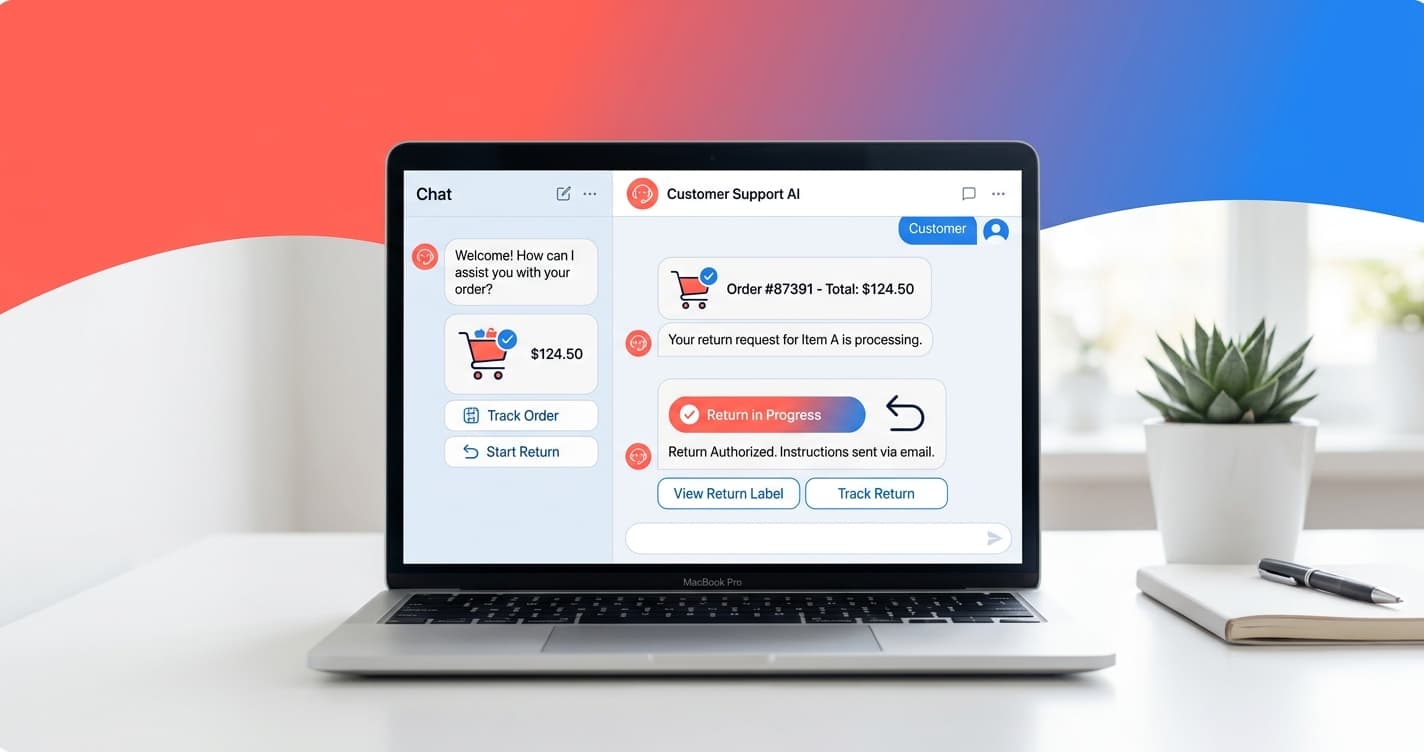
Customers start a return directly in the chat window. The bot collects the order number, confirms eligibility, presents return reason options, and generates a prepaid return label — all without a human ever touching it.
WISMO: Where Is My Order?
WISMO queries are the single largest category of e-commerce support tickets. A chatbot integrated with Shopify, WooCommerce, or your order management system pulls live tracking data and delivers it in under 5 seconds.
"Your order shipped October 14th via USPS. Current status: In transit, expected delivery October 18th. [Track Package]"
That's a resolved ticket in 8 seconds. Compare that to a 4-minute email response with a 2-hour lag.
Refund Status Updates
"Did you get my return? When do I get my money back?"
Once a return is scanned at your warehouse, the chatbot can pull that status and tell the customer exactly where things stand: received, processing, or refunded — with an expected timeline.
Exchange Handling
Instead of a full refund, does the customer want a different size or color? The chatbot presents available inventory, confirms the exchange, and routes it to your fulfillment system — reducing refund-driven revenue loss without any manual work.
Free Resource
Free Lead Audit Checklist
Find the 7 most common reasons your website visitors leave without converting.
Download FreeThe Numbers That Make the Case
AI chatbot ecommerce returns support doesn't just handle edge cases. It handles the majority of volume:
- WISMO queries: 35–50% of all support tickets — fully resolvable
- Policy questions: 15–20% — fully resolvable
- Return initiation: 10–15% — automatable with OMS integration
- Refund status: 10–12% — automatable with warehouse data
That's 70–97% of your return-related tickets that don't require a human. In practice, accounting for partial automation and edge cases, most businesses see 40–60% ticket reduction when they deploy a trained returns chatbot.
According to Salesforce's State of Service report, AI-assisted support teams resolve cases 30% faster and handle 3x the volume per agent. For returns automation, where queries follow predictable patterns, the gains are even larger.
Setting Up Returns Automation Without Breaking Existing Workflows
The biggest concern most operators have: "What if the chatbot gives a customer wrong information and makes things worse?"
It's a legitimate concern. Here's how to get this right:
Start with read-only queries. Don't give the chatbot write access to your OMS on day one. Begin with policy questions and tracking lookups. Expand to return initiation and label generation once accuracy is validated over two to three weeks of live traffic. This phased approach also gives your support team time to review edge cases and refine the knowledge base before the chatbot takes on more responsibility.
Define the escalation path clearly. Any question the chatbot can't answer with high confidence should escalate to a human via live chat or email. "I'm not sure about that — let me connect you with our team" is always a better outcome than a confident wrong answer.
Integrate with your order management system. A chatbot that can't access real order data can't answer real return questions. This integration is non-negotiable for WISMO and refund status. Without it, you're just building a fancy FAQ.
Train on your actual policy. Not a template. Your specific return window, your refund processing time, your exchange rules, your final sale exceptions. The chatbot needs your exact policy — not an approximation of someone else's.
Review escalations weekly for the first 30 days. Each escalated ticket represents a training gap. Identify the recurring categories, add them to the knowledge base with approved responses, and watch those ticket types disappear from your support queue over the following two weeks. After 60 days, most businesses find their chatbot handles 80–90% of return-related contacts end-to-end, with only unusual or emotionally charged situations needing a live agent.
What This Means for Your Team
Deploying AI chatbot ecommerce returns support doesn't mean cutting headcount. It means redeploying your team's time toward higher-value work.
Before automation, a typical e-commerce support team spends roughly 70% of agent hours on routine query responses. After automation, that same team spends the majority of its time on complex cases, proactive outreach, and retention work — the tasks that actually improve customer lifetime value.
Keeping a customer who had a bad return experience is worth five times more than simply processing the return. The chatbot processes the return. Your team keeps the customer.
Is Your Store Ready for This?
If your e-commerce business handles more than 50 support contacts per week and returns make up 25% or more of that volume, you're already past the threshold where automation delivers a positive return in the first month — not from cutting staff, but from freeing your existing team to do higher-value work. The setup investment for AI chatbot ecommerce returns support is typically recovered within four to six weeks, sometimes sooner if you're heading into a high-volume return season like post-holiday or post-Prime Day. Schedule a free demo to see how it would work for your specific catalog and return policies.